
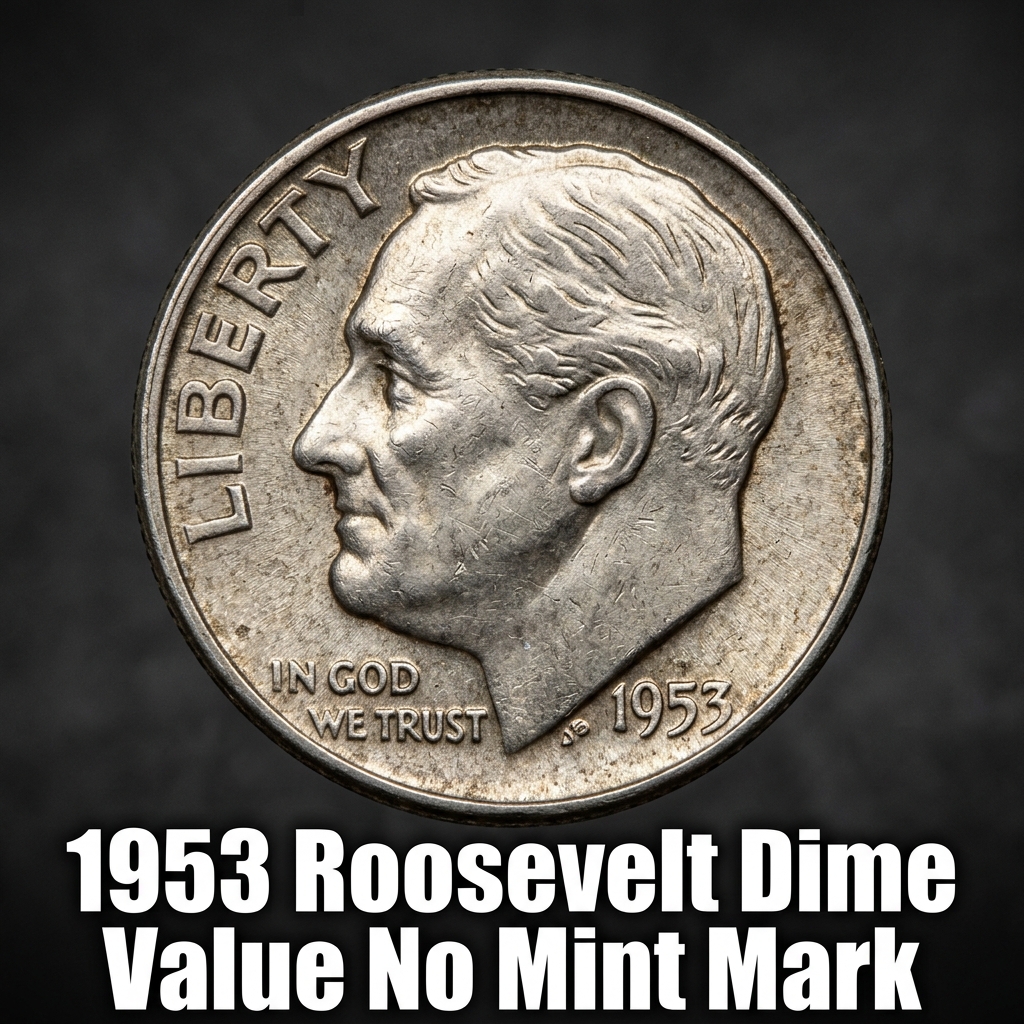
The 1953 Roosevelt Dime with no mint mark is worth anywhere from $2.50 in worn condition to over $600 in high-grade mint state. Finding one of these silver treasures in your pocket change or an old jar can be an exciting moment for any American looking to learn about numismatic history.
Understanding the 1953 Roosevelt Dime with No Mint Mark
If you have a 1953 dime and cannot find a small letter near the torch on the reverse, you have a coin struck at the Philadelphia Mint. During this era, the Philadelphia facility did not use a mint mark (unlike Denver’s “D” or San Francisco’s “S”). Collectors often refer to these as “plain” dates. Because these coins were minted over seventy years ago, they are composed of 90% silver and 10% copper, making them inherently valuable even if they are heavily worn.
In the mid-20th century, these dimes were the workhorses of the American economy. While millions were produced, many were lost to the silver melts of the late 1960s and 1980s when silver prices spiked. Today, identifying the exact condition of your coin is the first step in determining its true market worth. Using a top coin identifier app can help you quickly distinguish between a common circulated specimen and a rare high-grade variety that serious collectors desire.
When you are assessing your collection, tools like the CoinHix app can provide instant clarity on surface details. The value of a 1953 Roosevelt Dime is primarily driven by its “state of preservation.” Most coins found in everyday containers will be “Circulated,” meaning they show signs of wear on Roosevelt’s cheek or the vertical lines of the torch. However, if the coin retains its original luster, it is “Uncirculated,” and that is where the price significantly climbs.
Price Chart for 1953 Philadelphia Roosevelt Dimes
To give you a better idea of what your silver dime might be worth, we have compiled a price guide based on recent auction data and market trends. Keep in mind that professional grading by services like PCGS or NGC is usually required to reach the highest price points.
| Condition / Grade | Estimated Value |
|---|---|
| Good (G-4) to Fine (F-15) | $2.25 – $2.50 (Silver Value) |
| Extremely Fine (EF-40) | $3.00 – $4.50 |
| About Uncirculated (AU-50) | $5.00 – $8.00 |
| Mint State 63 (MS-63) | $12.00 – $18.00 |
| Mint State 65 (MS-65 Gem) | $30.00 – $45.00 |
| Mint State 67+ Fully Bands (FB) | $550.00+ |
Detailed analysis shows that the 1953 dime value for uncirculated grades can fluctuate based on the presence of “Full Bands,” which refers to the horizontal lines on the torch being fully separated and visible.
Total Mintage and Scarcity Factors
In 1953, the Philadelphia Mint produced 53,490,000 dimes. While this sounds like a massive number, it is relatively modest compared to the hundreds of millions minted in later decades. Because these were made of precious metal, many were withdrawn from circulation in 1965 when the U.S. Mint transitioned to copper-nickel “clad” compositions.
Finding a 1953 Roosevelt Dime with no mint mark in your pocket change is rare today, but not impossible. Most examples you will encounter are “culls” or “junk silver,” valued mostly for their metal content. However, for those looking for investment-grade pieces, you should check the current 1953 silver dime market price to see how premiums are performing for coins that possess exceptional eye appeal or attractive toning.
If you are unsure whether your coin is a regular strike or a Proof, look at the finish. Philadelphia also produced over 128,000 Proof coins in 1953 specifically for collectors. These have a mirror-like finish and sharp details. Using the CoinHix app can help you photograph your coin and compare it against known Proof specimens to ensure you aren’t overlooking a more valuable version of the 1953 Roosevelt Dime.
Key Features to Look for in a 1953 Plain Dime
When examining your 1953 Roosevelt Dime, focus on the reverse side. The “Full Bands” (FB) designation is the holy grail for Roosevelt Dime collectors. On the back of the coin, there is a torch in the center. At the top and bottom of the torch, there are horizontal bands. If these bands are perfectly split with a clear line of space between them, the coin is worth a significant premium.
Most 1953 dimes struck in Philadelphia suffer from “weak strikes,” meaning the details are slightly blurry. A crisp, sharp strike on a 1953 dime is quite rare. If you find one that looks like it was minted yesterday, with every hair strand on Franklin D. Roosevelt’s head visible, you might be holding a coin worth hundreds of dollars. Before you sell, it is wise to consult the CoinHix platform to see high-resolution images of what a “Full Band” coin looks like compared to a standard strike.
Additionally, look for “toning.” Some silver dimes develop beautiful rainbows of blue, gold, and magenta over decades of storage in old paper albums. Collectors often pay extra for “monster toned” 1953 dimes because each one is unique. Whether your coin is brilliant white or beautifully toned, the underlying silver value remains a solid floor for its price, ensuring it will never be worth just ten cents again.
Frequently Asked Questions
Q: How can I tell if my 1953 dime is silver?
A: All dimes minted in 1953 are made of 90% silver. You can tell by looking at the edge of the coin; if it is solid silver in color without a copper-colored stripe, it is a silver coin. Additionally, silver dimes have a distinctive high-pitched “ring” when gently tapped, compared to the duller thud of modern clad coins.
Q: Where is the mint mark on a 1953 Roosevelt Dime?
A: On a 1953 dime, the mint mark (if present) is located on the reverse side, at the bottom left of the torch, just above the date’s “E” in “ONE.” If there is no letter “D” or “S,” it was minted in Philadelphia.
Q: Is a 1953 dime worth more than its silver weight?
A: If the coin is in heavily circulated condition, its value is tied closely to the spot price of silver (usually about 0.0723 ounces of pure silver). However, if the coin is in Mint State (uncirculated) or has the “Full Bands” designation, its numismatic value far exceeds its melt value.
Q: Is there a 1953-D or 1953-S dime value difference?
A: Generally, the 1953-S (San Francisco) is slightly more sought after in lower uncirculated grades because it has the lowest mintage of the three. However, for the very highest grades (MS67 and above), the Philadelphia (no mint mark) strike can sometimes command higher prices due to the difficulty of finding them with “Full Bands.”