
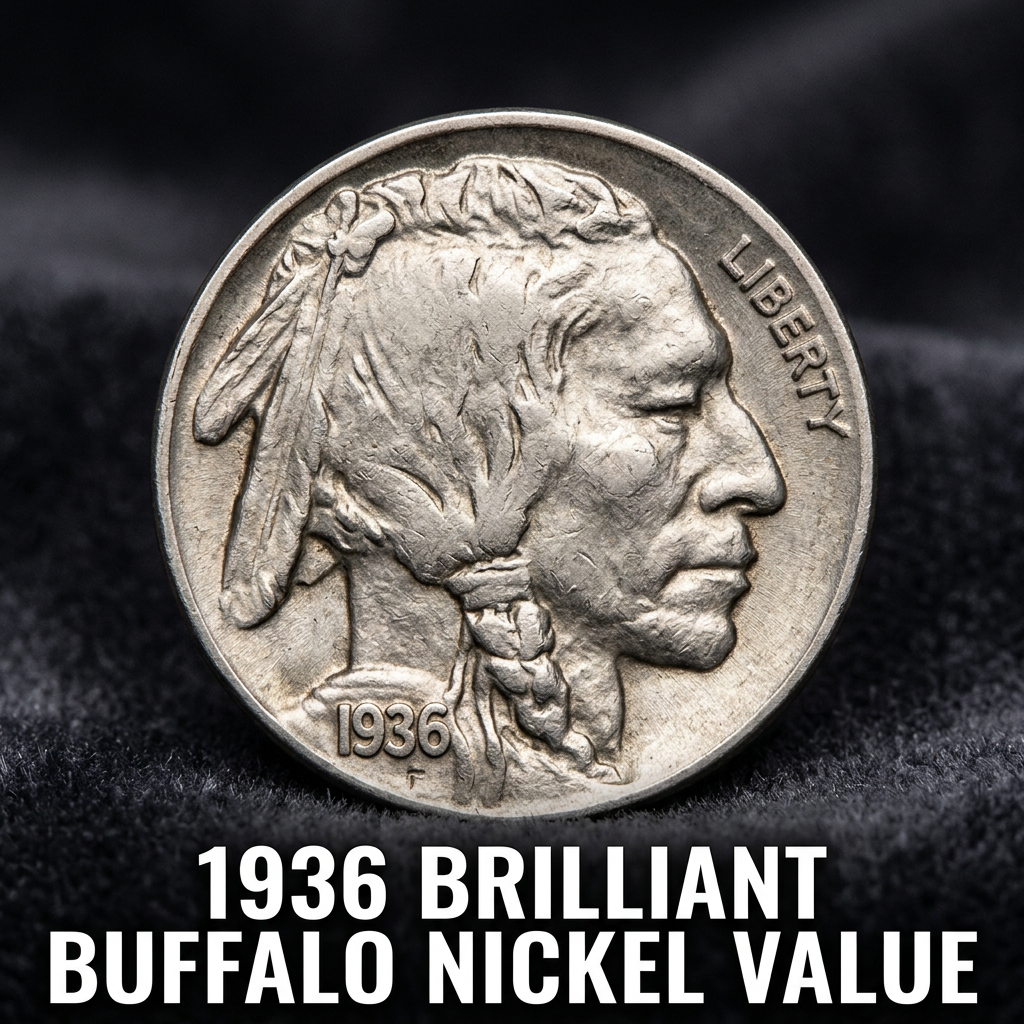
The 1936 Buffalo Nickel value ranges from about $1.50 in worn condition to over $150 for high-quality mint state coins. These iconic pieces of American history are favorites among casual collectors because they are relatively affordable yet feature one of the most beautiful designs ever minted by the United States.
Understanding the Market for 1936 Buffalo Nickels
If you just found an old nickel with a Native American profile on one side and a massive bison on the other, you are holding a “Buffalo Nickel,” officially known as the Indian Head Nickel. By 1936, the United States was beginning to recover from the Great Depression, and the mints were producing these coins in high volumes. To get an instant idea of what your pocket change is worth, you can use a top coin identifier app to scan your coin and get a preliminary grade.
While millions were made, most 1936 nickels spent decades in circulation, meaning they are often heavily worn. Collectors pay a premium for “Brilliant” examples—coins that still have their original mint luster and sharp details. If yours looks shiny and the horn on the buffalo is perfectly clear, you might be looking at a coin worth significantly more than its five-cent face value. For many beginners, using CoinHix is the fastest way to organize a growing collection and track these price fluctuations.
Identifying Mint Marks and Varieties
The value of your 1936 nickel depends heavily on where it was made. You can find the mint mark on the reverse side (the “tails” side), located just below the words “FIVE CENTS” and the buffalo’s mound. If there is no letter, it was minted in Philadelphia. An “S” indicates San Francisco, and a “D” indicates Denver. Generally, the Denver and San Francisco issues are slightly rarer than the Philadelphia ones in higher grades.
Beyond the standard issues, enthusiasts look for specific varieties. The most famous for this year is the 1936-D 3-and-a-half-legged buffalo, though this is much rarer than the 1937 version. You should also check for “doubled die” errors, where the lettering appears blurry or doubled. Checking the 1936 buffalo nickel professional grading data can help you determine if your specific mint mark carries a higher premium in today’s market.
Grading Your 1936 Buffalo Nickel
To determine the exact price, you must understand “grading.” Coins are graded on a scale from 1 to 70. A coin graded “Good” (G-4) will be very flat, with the date barely visible. A “Fine” (F-12) coin will show some detail in the hair braids and the buffalo’s coat. A “Mint State” (MS-60 and above) coin looks like it just came off the press.
Most people find coins in “Circulated” condition. In these cases, the date is the first thing to check. If the date is “mushy” or fading into the rim, the value stays near the lower end of the spectrum. However, if the date is bold and the buffalo’s tail is distinct, you have a mid-grade coin. Modern tools like CoinHix allow you to compare your coin against high-resolution images to estimate the grade yourself before sending it to a professional service.
1936 Buffalo Nickel Price Table
Below is a breakdown of the current market values for the 1936 Buffalo Nickel across different mints and conditions. Please note that professional certification (NGC or PCGS) is usually required to fetch top-tier prices.
| Mint Mark | Good (G-4) | Fine (F-12) | Extremely Fine (XF-40) | Uncirculated (MS-63) |
|---|---|---|---|---|
| 1936 (Philadelphia) | $1.50 | $2.50 | $8.00 | $45.00 |
| 1936-D (Denver) | $2.00 | $3.50 | $12.00 | $60.00 |
| 1936-S (San Francisco) | $2.00 | $4.00 | $15.00 | $65.00 |
| 1936 Proof | N/A | N/A | N/A | $1,000+ |
Why Condition Matters Most for Your Collection
A “Brilliant” 1936 nickel is one that has escaped the friction of everyday commerce. When a coin is passed from hand to hand, the highest points of the design—the cheekbone of the Native American and the hip of the buffalo—are worn down first. A truly high-value 1936 nickel will maintain “luster,” which is the frosty sheen created by the minting process.
If you find a coin that looks brand new, do not clean it! Cleaning a coin with chemicals or cloth can actually destroy its numismatic value by leaving tiny scratches. Instead, keep it in a soft flip or a plastic holder. If you are unsure about its state, the CoinHix community and appraisal tools can provide guidance on whether your find is worth the cost of professional grading.
Common Questions About the 1936 Indian Head Nickel
How can I tell if my 1936 nickel is a Proof?
A: Proof coins were minted specifically for collectors and have a mirror-like finish or a very sharp, frosted detail. In 1936, the mint produced both “Satin” and “Brilliant” proofs. These are very rare and typically worth over $1,000. If your coin was found in a jar of change, it is almost certainly a regular business strike, not a proof.
Is there a 1936 “Three-Legged” Buffalo nickel?
A: While the 1937-D 3-legged variety is the most famous, there is a much rarer 1936-D 3-and-a-half legged variety. This occurs when the die used to stamp the coin was polished too heavily, removing part of the buffalo’s front leg. If the front leg looks faint or partially missing, have it examined by a professional.
What is the most valuable 1936 nickel ever sold?
A: High-grade specimens can reach incredible prices at auction. A 1936 Buffalo Nickel graded MS-68 (nearly perfect) can sell for over $30,000. These are extremely rare and were likely preserved in a collection immediately after being minted.
Should I sell my 1936 nickel now?
A: The market for Buffalo Nickels is very stable. Because they are a “staple” of American coin collecting, there is always demand. If you have a common circulated coin worth $2, it may not be worth the effort to sell individually. However, if you have a group of them or a single high-grade “brilliant” specimen, selling to a reputable coin dealer or through a collectors’ platform is a great way to realize its value.