
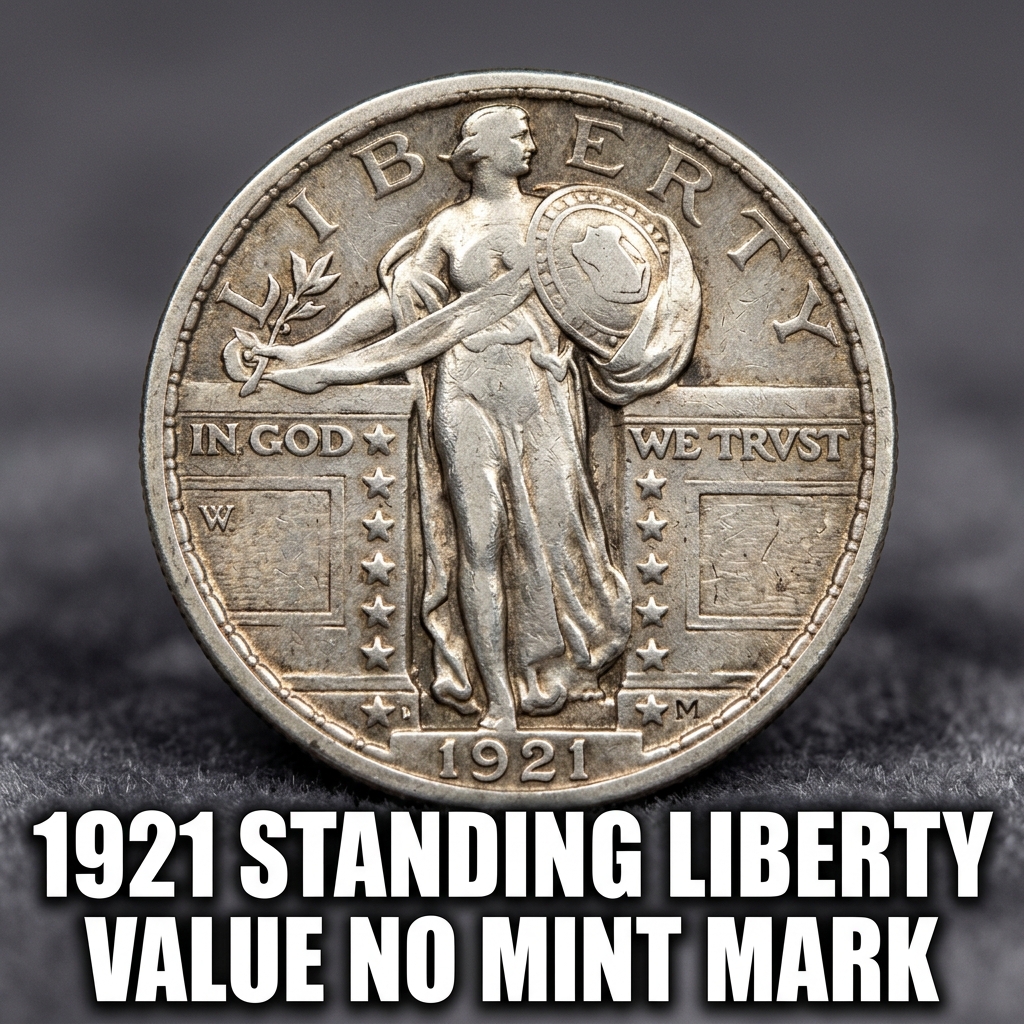
The 1921 Standing Liberty Quarter is worth anywhere from $150 in heavily worn condition to over $15,000 for high-grade specimens with full details. This particular year is considered a “key date” in the series, making it a dream find for any casual collector or someone searching through a family inheritance.
Why the 1921 Standing Liberty Quarter is a Rare Treasure
If you have stumbled upon a 1921 Standing Liberty Quarter with no mint mark, you are looking at one of the most sought-after coins in American numismatics. Most people don’t realize that a simple quarter could be worth hundreds or even thousands of dollars. Using a top coin identifier app can help you quickly confirm the year and type, but the 1921 issue is special because of its incredibly low mintage. In 1921, the Philadelphia Mint struck only 1,916,000 of these quarters, a tiny number compared to the tens of millions produced in other years.
Because of the post-WWI economic recession, the demand for new coinage was low, leading to this limited production. For everyday Americans, finding one of these in a jar of old change is like winning a mini-lottery. If you are unsure about the authenticity of your coin, the CoinHix app can provide high-resolution comparisons to help you spot the genuine features of a 1921 Philadelphia issue. These coins are distinct because they lack a mint mark (found to the left of Liberty’s foot), signifying they were minted in Philadelphia.
Because this coin was released into general circulation during a time when people spent every penny they had, most surviving examples are very worn. Finding one with Crisp details is extremely rare. Whether you are a seasoned collector or just curious about a coin you found, the 1921 quarter value remains high across almost all grading scales due to the sheer scarcity of the date.
Grading and Determining Your 1921 Quarter Value
The value of your 1921 Standing Liberty Quarter depends almost entirely on its “grade” or condition. Because the design of Lady Liberty on this coin features high points that wear down quickly, even a small amount of circulation can drastically change the price. Collectors look for specific details like the “Full Head” (FH) designation, which refers to the clarity of the helmet on Lady Liberty’s head. If the hair and helmet are distinctly visible, the price skyrockets.
For those checking their coins at home, look at the date first. On early Standing Liberty Quarters, the date was raised and often wore away completely. A 1921 quarter with a clearly legible date is already worth a significant premium. If you want to see how your coin compares to professional standards, checking the 1921 Standing Liberty Quarter auction records can give you a realistic idea of what buyers are currently paying for various conditions.
If your coin is shiny and looks like it never went into a pocket, it might be in “Mint State.” These are the holy grails of the 1921 series. Even a small scratch or “bag mark” can be the difference between a $2,000 coin and a $10,000 coin. Utilizing tools like CoinHix can help you zoom in on these imperfections that the naked eye might miss, ensuring you don’t undersell a valuable piece of history.
1921 Standing Liberty Quarter Price Comparison Chart
To help you understand the market values, we have compiled a table based on the standard Sheldon Grading Scale. “No Mint Mark” refers to the Philadelphia striking. Please note that these prices are estimates based on recent market trends and auction results.
| Condition / Grade | Estimated Market Value |
|---|---|
| Good (G-4) – Heavily Worn | $150 – $185 |
| Very Good (VG-8) – Clearer Outline | $250 – $320 |
| Fine (F-12) – Visible Drapery | $450 – $550 |
| Very Fine (VF-20) – Moderate Detail | $750 – $900 |
| Extremely Fine (EF-40) – Sharp Details | $1,200 – $1,500 |
| About Uncirculated (AU-50) – Trace Wear | $1,800 – $2,200 |
| Mint State (MS-63) – No Wear | $3,500 – $5,000 |
| Mint State (MS-65 Full Head) – Gem Quality | $12,000 – $18,000+ |
Identifying Mint Marks and Key Features
When examining a Standing Liberty Quarter, the “No Mint Mark” status means the coin was produced at the Philadelphia Mint. On other years, you might see an ‘S’ for San Francisco or a ‘D’ for Denver. For the 1921 issue, however, only Philadelphia produced quarters. This makes the identification process a bit simpler, as you only need to focus on the date and the condition of the strike.
The design itself is a work of art by Hermon A. MacNeil. It features Liberty walking through a gateway, holding a shield and an olive branch. On the 1921 version (Type 2 redesign), the eagle on the reverse is positioned higher on the coin, and there are stars below the eagle. Because the 1921 is a high-value key date, counterfeiters sometimes try to alter other years to look like a 1921.
Before you take your coin to a dealer, use the CoinHix app to verify the specific font and spacing of the “1921” digits. Professional third-party grading by services like PCGS or NGC is highly recommended for this specific coin, as a certified grade ensures you get top dollar when selling. Without a professional slab, many buyers will be hesitant to pay the full market price due to the risk of counterfeit or cleaned coins.
The “Full Head” Bonus for 1921 Quarters
In the world of Standing Liberty Quarters, the term “Full Head” (FH) is the gold standard. This refers to a coin that was struck so well that every detail of Lady Liberty’s head—including the three leaves on her helmet and the ear hole—is perfectly visible. Most 1921 quarters were struck quite well, but many lost these details through circulation.
If you have a 1921 quarter that looks uncirculated, check the head with a magnifying glass. If the details are sharp, its value could double or even triple compared to a standard Mint State version. This strike quality is highly prized by collectors who want the absolute best examples of this “key date” year. Even for a casual finder, knowing the difference between a standard 1921 and a Full Head 1921 can be a $5,000 difference.
Always handle your coin by the edges to avoid getting oils from your skin on the surface, which can damage the “luster” (the original mint frost). A well-preserved 1921 quarter is a piece of American history from the “Roaring Twenties,” reflecting a time of immense change and artistic flourish in US coinage history.
Frequently Asked Questions About the 1921 Quarter
Q: Is the 1921 Standing Liberty Quarter rare?
A: Yes, it is considered a “key date” because it has the second-lowest mintage in the entire series. Only about 1.9 million were made, making it much rarer than most other quarters from that era.
Q: Where is the mint mark on a 1921 quarter?
A: Mint marks on Standing Liberty Quarters are located just to the left of Lady Liberty’s foot, right above the date. If there is no letter there, it was minted in Philadelphia.
Q: How can I tell if my 1921 quarter is real?
A: Look for the specific shape of the “1” and “2” in the date. Authenticating through a professional grading service or using an app like CoinHix to compare your coin to known genuine examples is the best way to be sure.
Q: What is the most expensive 1921 quarter ever sold?
A: High-grade 1921 quarters in MS-67 condition with the Full Head designation have sold at auction for over $50,000. Most found in “raw” or circulated condition sell for between $200 and $1,000.