
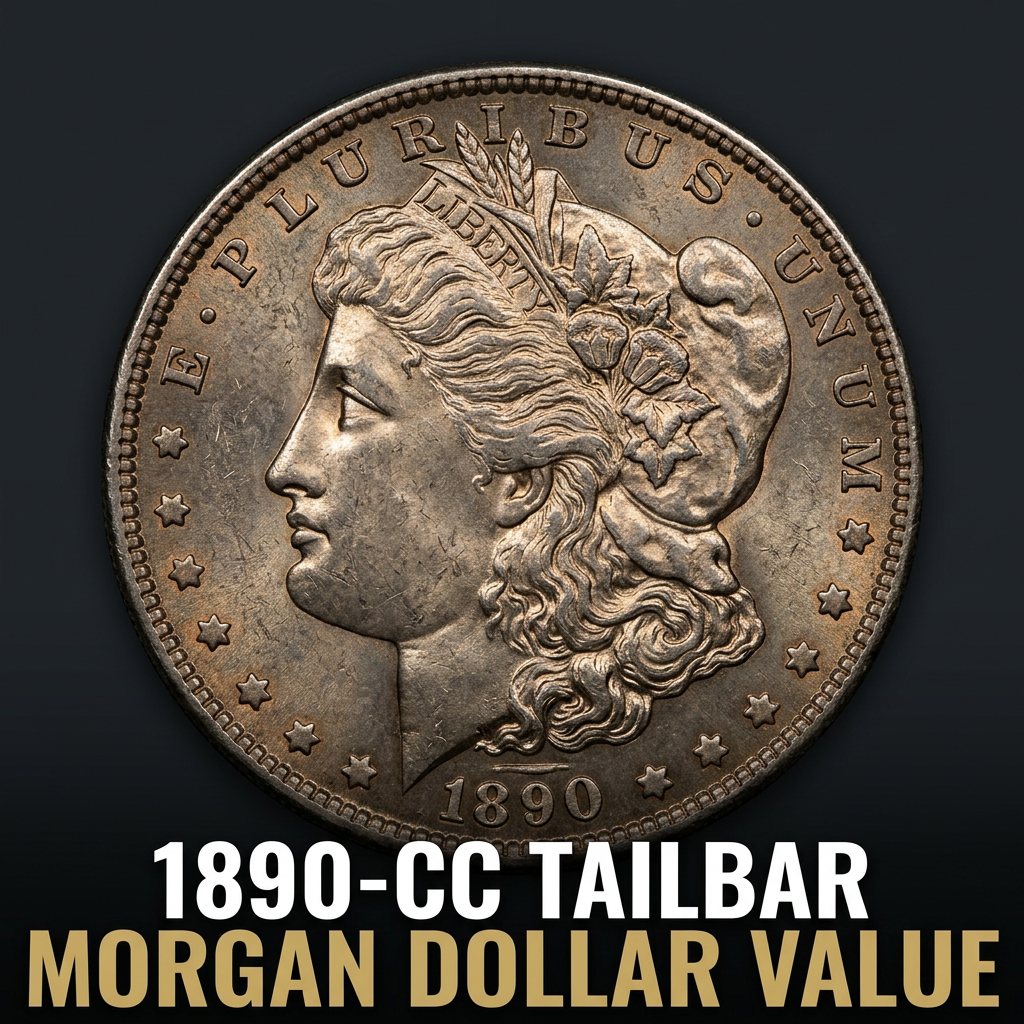
The 1890-CC Tailbar Morgan Dollar is worth anywhere from $600 in heavily circulated condition to over $25,000 for high-grade uncirculated specimens. This specific variety, struck at the famous Carson City Mint, features a unique die gouge that makes it one of the most sought-after treasures for everyday collectors and silver enthusiasts alike.
Why the Tailbar Morgan Dollar Is So Special
Finding an old silver dollar in a drawer or a family collection is always exciting, but discovering an 1890-CC VAM-4 “Tailbar” is like winning a mini-lottery. This coin is distinguished by a vertical line protruding from the eagle’s tail feathers on the reverse side, reaching down to the wreath. This wasn’t an intentional design choice; it was caused by a piece of steel or debris accidentally gouged into the coin die during production. Because only a limited number of coins were struck with this specific damaged die before it was replaced or polished, the “Tailbar” is significantly rarer than the standard 1890-CC Morgan Dollar.
If you aren’t sure if your coin has this specific mark, using a top coin identifier app can help you zoom in on those tiny details. Most everyday Americans might mistake the mark for a simple scratch, but to a numismatist, that “scratch” represents a high-value error. Using the CoinHix app can also provide high-resolution references to compare your coin against verified authentic Tailbar examples. Because the Carson City Mint (CC) already carries a legendary status in American history, any variety from this branch is automatically more prestigious.
Determining the Condition and Grade of Your 1890-CC
The value of your 1890-CC Tailbar is heavily dependent on its “grade,” or its state of preservation. Coins are graded on a scale from 1 to 70. A coin that has been carried in a pocket for years might be graded “Good” (G-4) or “Very Fine” (VF-20), showing significant wear on Lady Liberty’s hair and the eagle’s breast feathers. However, even in low grades, this coin retains a high baseline value because of its CC mint mark and the Tailbar variety. If your coin still has its original mint luster and looks like it just came from the bank, it could be in “Mint State” (MS) condition.
Professional grading services like PCGS or NGC are the industry standard for verifying these high-value items. Before you spend money on professional grading, you can get a preliminary estimate by checking the 1890-CC Tailbar price data for uncirculated grades. Small details, such as the number of contact marks on Liberty’s cheek or the sharpness of the “CC” mint mark, can result in a price difference of thousands of dollars. Always handle your silver dollars by the edges and never attempt to clean them, as cleaning a rare coin can strip away over 50% of its market value instantly.
Current Market Value and Price Comparison Table
The market for Carson City silver dollars is extremely robust. Unlike common-date Morgans that fluctuate mainly with the spot price of silver, the 1890-CC Tailbar is valued as a collectible antique. While a standard 1890-P Morgan might sell for $30, the Tailbar variety starts in the mid-hundreds. Collectors are willing to pay a premium for the “Wild West” history associated with the Nevada mint. To understand how much you might receive if you sold your coin today, consult the 1890 CC Morgan dollar value guide to see how the Tailbar stacks up against general 1890 issues.
| Condition / Grade | Estimated Value (USD) |
|---|---|
| Very Fine (VF-20) | $650 – $850 |
| Extremely Fine (XF-40) | $1,100 – $1,400 |
| About Uncirculated (AU-50) | $2,200 – $2,800 |
| Mint State (MS-63) | $7,500 – $9,500 |
| Gem Mint State (MS-65+) | $25,000+ |
How to Spot the Tailbar Variety on Your Coin
To identify an 1890-CC Tailbar, you need a magnifying glass or a high-quality smartphone camera. Flip the coin over to the reverse side (the side with the eagle). Look specifically at the eagle’s tail feathers, just above the “D” and “O” in the word “DOLLAR.” You are looking for a raised, vertical line that looks like an extra feather or a bar extending from the feathers down toward the wreath. This is the “Tailbar.” If your coin has this mark and the “CC” mint mark below the wreath, you are looking at one of the most famous Morgan dollar varieties in existence.
For those who find the visual identification difficult, the CoinHix app utilizes image recognition technology to help flag potential VAM varieties. It is also important to verify the “CC” mint mark. Some counterfeiters in the past have attempted to glue “CC” marks onto common Philadelphia-minted coins. However, the Tailbar die gouge is very specific and much harder to fake convincingly. Checking the weight (which should be 26.73 grams) and the diameter (38.1 mm) is a good first step in ensuring your find is authentic before taking it to a professional dealer.
The Historical Context of the Carson City Mint
The Carson City Mint was established to be near the Comstock Lode, a massive silver deposit in Nevada. During the late 1800s, the mint produced coins that represented the American frontier. The year 1890 was particularly interesting as it saw a high production of Morgan Dollars compared to other CC years, yet the “Tailbar” remains scarce because it occurred due to a specific die accident. Owning an 1890-CC Tailbar isn’t just about the silver content—which is 90% silver—it is about owning a piece of the Old West that survived through over a century of American history.
Because these coins are so valuable, they are often the centerpiece of “bank bag” finds or estate sales. If you have inherited a collection, searching for the “CC” mark should be your priority, and within that search, identifying the Tailbar gouge is the next level of valuation. Modern collectors value these errors because they tell a story of the minting process itself, showing that even the United States Mint made mistakes that turned into valuable treasures. Keeping your coin in a protective flip or capsule is essential to maintaining its current value.
FAQ
Q: Is every 1890-CC Morgan Dollar a Tailbar?
A: No. The Tailbar is a specific variety (known as VAM-4). While all 1890-CC coins are valuable, the Tailbar variety carries a significant price premium over the standard 1890-CC due to its rarity and the “error” status.
Q: Where can I sell my 1890-CC Tailbar?
A: High-value coins like this are best sold through reputable auction houses (such as Heritage or Stack’s Bowers) or to specialized coin dealers. Using the CoinHix app can help you find recent auction results to ensure you get a fair price.
Q: Should I clean my 1890-CC Tailbar to make it look better?
A: Absolutely not. Cleaning a coin with chemicals or cloths creates microscopic scratches that professional graders can easily spot. A “Cleaned” grade will significantly lower the market value of your rare silver dollar.
Q: How can I tell if my coin is a fake?
A: Genuine Morgan Dollars are non-magnetic and weigh approximately 26.73 grams. If your coin sticks to a magnet or weighs significantly less (like 24 or 25 grams), it is likely a counterfeit. Using a professional scale and a magnet test is a good starting point for home authentication.