
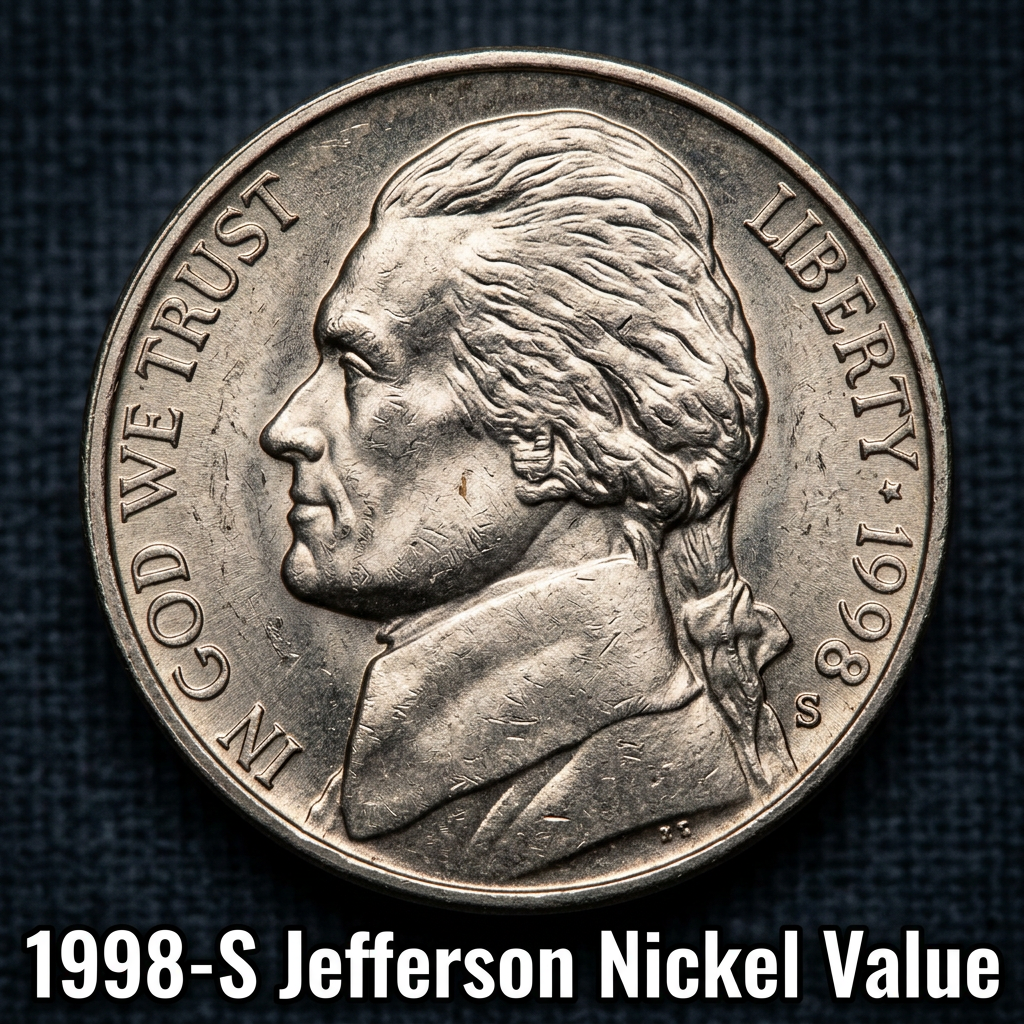
The 1998 S Jefferson Nickel is worth anywhere from $3 in typical proof condition to over $50 for high-grade specimens with Deep Cameo finishes. While you likely won’t find this specific “S” mint mark coin in your pocket change, it remains a popular and affordable piece for anyone starting a coin collection today.
What Makes the 1998 S Jefferson Nickel Special
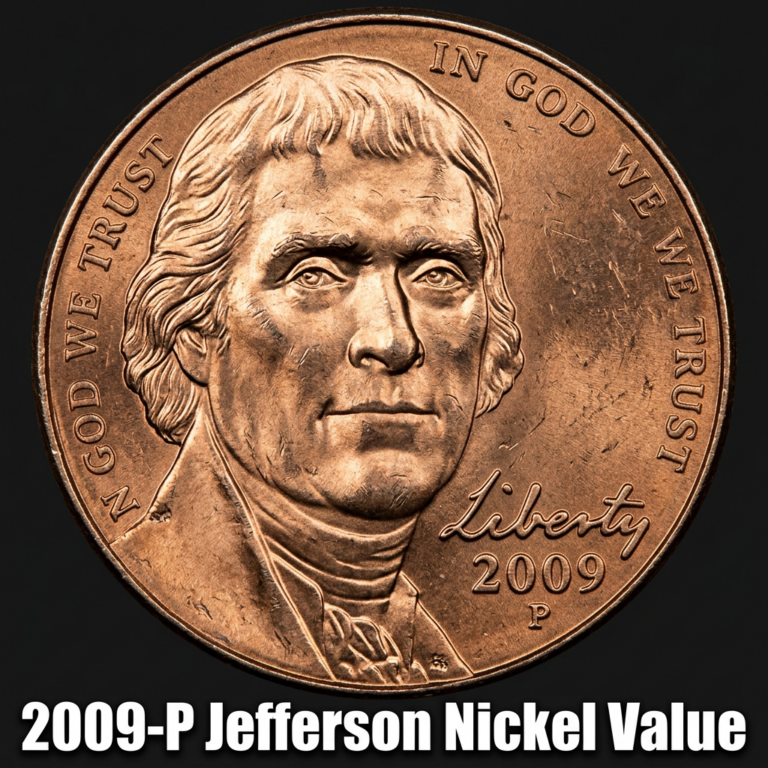
If you have discovered a nickel dated 1998 with a small “S” next to the building on the back, you are looking at a proof coin. Unlike the millions of nickels made in Philadelphia or Denver for daily commerce, these were produced at the San Francisco Mint specifically for collectors. You can quickly identify these by their mirror-like backgrounds and frosted details, which make Thomas Jefferson’s portrait pop. If you are unsure of the origins of your find, using a top coin identifier app can help you distinguish between a standard circulation strike and a proof strike.
Most people who find these coins today likely inherited a proof set or found one that was “broken out” of its original plastic packaging. Because they were never intended to spend at the grocery store, they are usually in much better condition than your average nickel. If you want to keep track of your growing collection and see how these specialized mint marks affect your hobby, the CoinHix app is a fantastic tool for organizing your inventory on the go.
Grading and the 1998 S Proof Nickel Value
When determining the value of your 1998 S Jefferson Nickel, condition is everything. Professional graders use a 70-point scale, and since proof coins were handled with care at the mint, most “S” nickels will fall between PR 67 and PR 70. A coin with a “Perfect 70” grade can command a significant premium because it has no visible flaws even under magnification. You can find detailed 1998 nickel price trends by grade to see how much a perfect specimen has sold for at recent auctions.
Another factor is the “Cameo” effect. In 1998, the San Francisco Mint was very good at producing “Deep Cameo” (DCAM) coins. This refers to the heavy contrast between the shiny, reflective field of the coin and the white, frosted appearance of Jefferson’s face and the Monticello building. If your coin looks like a black-and-white photograph because of this contrast, it is far more desirable to collectors. Checking your coin against the CoinHix database can help you see high-resolution examples of what a Deep Cameo should look like.
| Condition / Grade | Estimated Market Value |
|---|---|
| PR 67 (Deep Cameo) | $3.00 – $5.00 |
| PR 68 (Deep Cameo) | $7.00 – $12.00 |
| PR 69 (Deep Cameo) | $15.00 – $25.00 |
| PR 70 (Deep Cameo) | $50.00 – $120.00+ |
Common Errors and Variations in 1998 Nickels
While the 1998 S is generally a very consistent coin, collectors often look for errors in the 1998 series as a whole to find real value. In the broader 1998 nickel production year, common errors include “Double Dies” or “Off-Center Declines.” While rare in proof coins because of the extra quality control, a 1998 S with a clear doubling of the letters or date would be an incredibly high-value find. Professional collectors often reference a 1998 Jefferson nickel valuation guide to understand which specific errors have been verified by grading services like PCGS or NGC.
If you suspect your coin has a “Full Steps” (FS) designation, keep in mind this usually applies to business strikes (P and D mint marks). However, most proof nickels naturally have full steps on the Monticello building because they are struck twice with higher pressure. If you are looking at a 1998-P or 1998-D instead of an “S”, the presence of five or six clear steps on the back is the main key to higher value. Using CoinHix allows you to scan the coin and identify these subtle physical features that the untrained eye might miss.
The Rarity of the 1998 Matte Finish Silver Premiere
It is important to note that 1998 was a special year for the Jefferson Nickel due to the “Matte Finish” version found in the 1998 Black Patriots Coin and Currency Set. While the 1998 S we are discussing is the shiny proof version, the Matte Finish version (also with an S mint mark) is much rarer, with only about 25,000 produced. This specific matte coin looks dull and satin-like, almost like it was sandblasted. If your 1998 S nickel doesn’t shine like a mirror but instead has a smooth, textured look, you might have found a coin worth hundreds of dollars.
For most casual hunters, the mirror-like 1998 S proof is the one you will encounter. Even though it isn’t worth a fortune, it serves as a beautiful centerpiece for a “year set.” Many families keep these coins as gifts for children born in 1998. Whether you have a shiny proof or a rare matte version, knowing the difference is the first step in successful coin collecting. Always keep your coins in protective flips to prevent oils from your skin from tarnishing the delicate finish of these San Francisco minted treasures.
Frequently Asked Questions
Q: How can I tell if my 1998 nickel is a proof coin?
A: Look for the “S” mint mark on the right side of the Monticello building on the reverse. Additionally, 1998 S proof coins have a mirror-like background and a distinctive frosty finish on the portrait of Jefferson, which is much more detailed than a regular nickel.
Q: Is a 1998 S nickel made of silver?
A: No, the 1998 S Jefferson Nickel is made of a standard copper-nickel composition (75% copper and 25% nickel). Unlike some special quarters or dimes, there were no 35% or 90% silver nickels produced for the general proof sets in 1998.
Q: Can I find a 1998 S nickel in my pocket change?
A: It is very rare but possible. This usually happens when someone spends a proof set by accident. If found in circulation, the coin will likely be scratched and lose its mirror-like “proof” status, which significantly lowers its value to nearly face value.
Q: What is the most expensive 1998 nickel ever sold?
A: High-grade 1998 nickels with “Full Steps” or the rare Matte Finish can sell for $500 to $1,000 at major auctions. The common 1998 S proof usually tops out around $100 for a perfect PR 70 Deep Cameo specimen.