
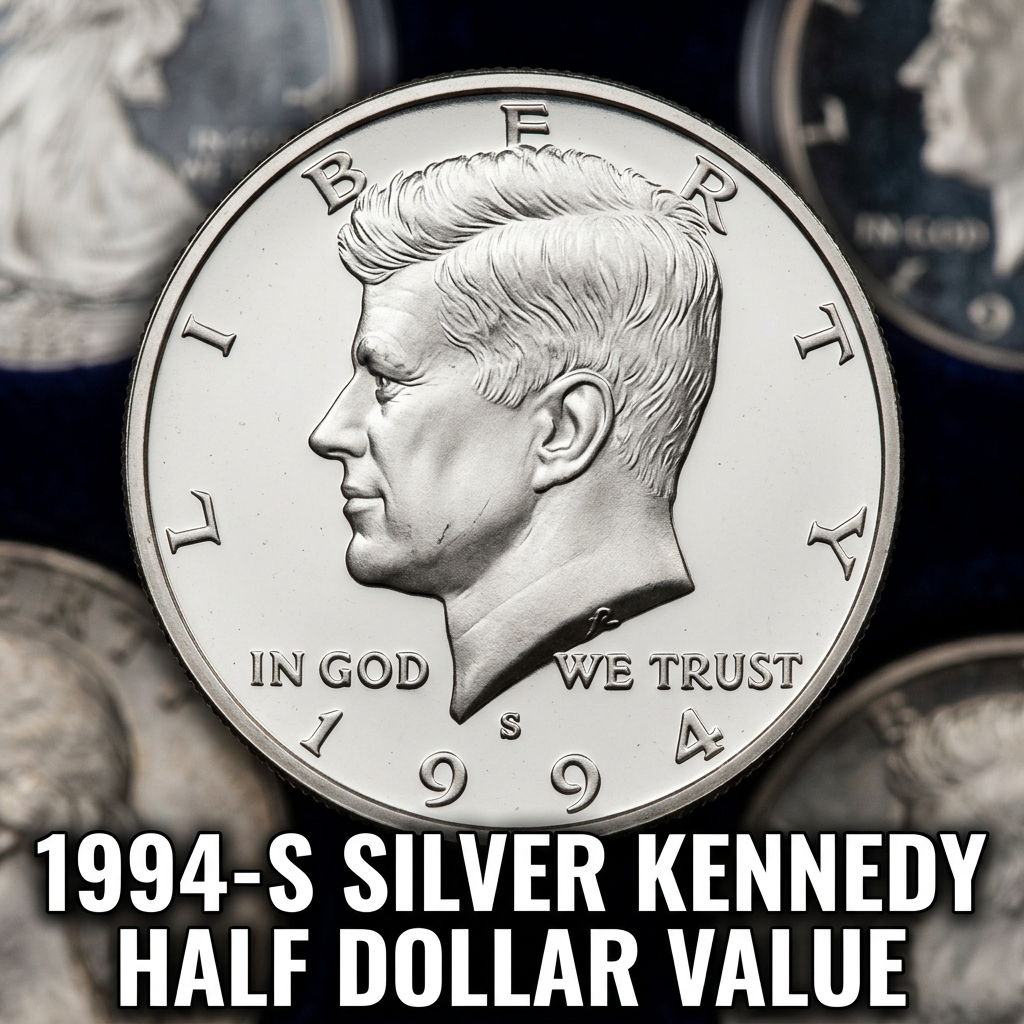
The 1994-S Silver Kennedy Half Dollar is worth anywhere from $15 in standard Proof condition to over $100 for pristine Deep Cameo specimens. Finding one of these shiny treasures in a collection is an exciting moment for any casual hobbyist or lucky discoverer looking to turn metal into cash.
Understanding the Special Nature of the 1994-S Silver Kennedy Half Dollar
If you have stumbled upon a 1994 Kennedy Half Dollar with an “S” mint mark, you aren’t looking at ordinary pocket change. Most half dollars minted in the 1990s were made for circulation using a copper-nickel clad composition, but the San Francisco Mint produced a special version specifically for collectors. This version is struck in 90% silver, making it a “precious metal” coin rather than just a base-metal piece.
Because these were never intended to be spent at the grocery store, they usually arrive in protective plastic lenses or sets. If you find one “loose,” it likely escaped from a broken collection. To quickly verify exactly what you have, many modern collectors use a top coin identifier app to differentiate between the silver proof and the standard clad versions by looking at the coin’s edge.
If you aren’t sure about the authenticity or condition of your find, the CoinHix app can provide instant visual recognition. Knowing the difference between a silver proof and a clad proof is the first step in determining if you are holding a $1 coin or something significantly more valuable.
How Much Is a 1994-S Silver Kennedy Half Dollar Worth Today
The value of the 1994-S Silver Kennedy Half Dollar is tied to two main factors: the current spot price of silver and the numismatic (collector) grade. Since the coin contains approximately 0.3617 troy ounces of pure silver, it will always have an intrinsic “melt value” that fluctuates with the metals market. However, because this is a Proof coin, its collector value almost always exceeds its silver content.
In most cases, a 1994-S Silver Half Dollar in a standard PR69 grade (nearly perfect) sells for roughly $20 to $30. If the coin has achieved the elusive PR70 grade from a professional grading service like PCGS or NGC, the price can skyrocket. You can track the latest trends and 1994 Kennedy half dollar market prices to see how recent auctions have performed for these high-grade specimens.
While the “S” mint mark denotes the San Francisco Mint, it is important to remember that they also made non-silver proof coins the same year. Always check the edge of the coin; a silver proof will have a solid silver-colored edge, whereas a clad coin will show a distinct copper stripe.
| Coin Condition/Grade | Estimated Market Value |
|---|---|
| Ungraded / Melt Value (Raw) | $10.00 – $14.00 |
| Proof 67 (Minor Imperfections) | $15.00 – $18.00 |
| Proof 69 Deep Cameo (Near Perfect) | $25.00 – $35.00 |
| Proof 70 Deep Cameo (Perfect) | $120.00 – $250.00 |
Visual Characteristics of the 1994 Silver Proof Half Dollar
When examining your coin, you will notice that the 1994-S Silver Kennedy Half Dollar looks much more “mirrored” than a standard coin. This is because Proof coins are struck using polished dies and specially prepared blanks. The “Deep Cameo” (DCAM) designation refers to the sharp contrast between the frosted white features of President John F. Kennedy and the mirror-like shiny background fields.
Because these coins were handled with care at the mint, any scratches, fingerprints, or dullness will significantly impact the price. Collectors want these coins to look as though they were just minted yesterday. If you are curious about how your silver proof compares to circulating versions from other years, you can look up 1994 silver and clad half dollar value data to see the vast difference in rarity.
Using the CoinHix mobile tool allows you to zoom in on the details of the “S” mint mark and the surface texture. This is particularly helpful because the San Francisco Mint used high-quality production standards in 1994, making these some of the most beautiful coins in the entire Kennedy series.
Factors That Influence the Final Sale Price
Why does one 1994-S Silver Half Dollar sell for $15 while another sells for $150? The answer almost always lies in “Eye Appeal” and professional certification. A coin encased in a plastic “slab” by a reputable grading service provides a guarantee of its silver content and its physical condition, making it much easier to sell to high-end collectors.
Tarnish, also known as “toning,” can also play a role. While many people think a shiny coin is best, some collectors pay a premium for silver coins that have developed beautiful rainbow colors over time due to natural oxidation. However, for 1990s proofs, most buyers still prefer the “Blast White” look of a pure, untarnished silver surface.
If you are planning to sell your coin, remember that local coin shops will usually offer you a price slightly below the retail value so they can make a profit. Online marketplaces like eBay may net you a higher price, but you must factor in shipping costs and seller fees. The CoinHix app can help you estimate these margins before you decide where to sell.
FAQ: Common Questions About the 1994-S Silver Kennedy Half Dollar
Q: Is every 1994 Kennedy Half Dollar made of silver?
A: No. Most 1994 half dollars (from Philadelphia and Denver) are made of copper and nickel. Only the special “S” mint mark Proof coins found in Silver Proof Sets contain 90% silver.
Q: How can I tell if my 1994-S is silver or clad without a scale?
A: Look at the edge of the coin. If you see a solid silver stripe with no trace of brown or copper, it is almost certainly the 90% silver version. If you see a copper ring, it is a standard clad proof.
Q: Should I clean my 1994-S Silver Half Dollar to make it worth more?
A: Never clean your coins! Even a soft cloth can leave microscopic scratches that destroy the “Proof” finish and significantly lower the collector value. Keep the coin in its original holder or a PVC-free flip.
Q: Where is the mint mark located on the 1994 Kennedy Half Dollar?
A: The mint mark is located on the obverse (front) of the coin, just above the date and below the truncated neck of President Kennedy’s portrait.