
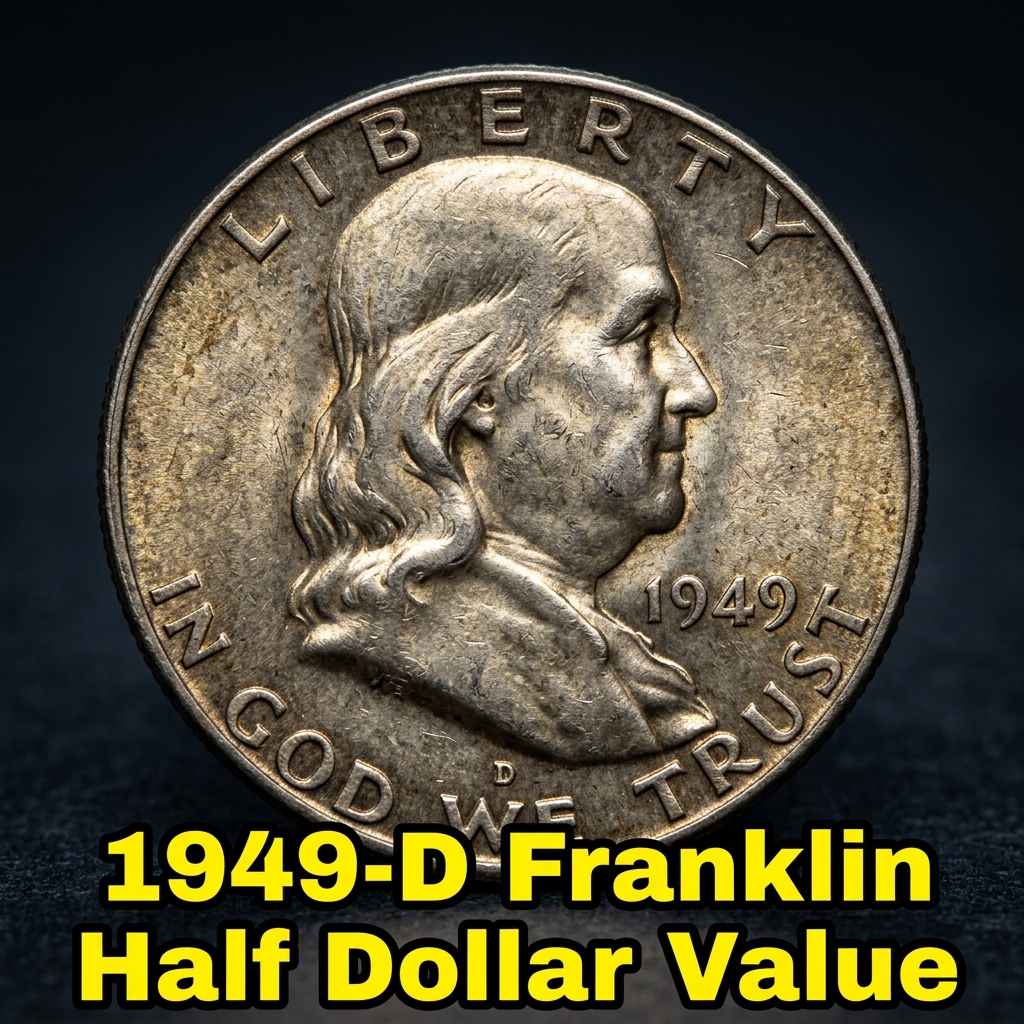
The 1949-D Franklin Half Dollar is worth anywhere from $15 in average circulated condition to over $3,500 in high-grade mint state with Full Bell Lines. These silver coins are favorites among collectors because they represent a classic era of American history and contain a significant amount of precious metal.
Understanding the Silver Content and Basic Worth
If you just found a 1949-D Franklin Half Dollar in an old jar or a inherited collection, the first thing you should know is that it is made of 90% silver and 10% copper. Because of this high silver content, the coin will always be worth significantly more than its fifty-cent face value, regardless of how worn it looks. Even if the coin is scratched or heavily circulated, its “melt value” provides a solid floor for its price.
To get a better sense of whether your specific coin is a common treasure or a rare gem, you can use a top coin identifier app to analyze the surface conditions. While the silver weight is the baseline, the “D” mint mark on the reverse side above the Liberty Bell signifies it was minted in Denver. In 1949, the Denver Mint produced just over 4 million of these coins, which is a relatively low mintage compared to later years in the series, making even circulated copies desirable to collectors.
Using the CoinHix app can help you determine if your coin has reached a grade where collector premium takes over the silver value. Generally, for a 1949-D half dollar, once the coin shows original mint luster and minimal scratches, the price begins to climb quickly beyond the $20 mark.
How Grading Impacts the 1949-D Franklin Half Dollar Value
In the world of coin collecting, the “grade” or condition of the coin is everything. Professional graders use a scale from 1 to 70. Most coins found in change are “Circulated” (Very Good to About Uncirculated), while those that never entered public use are “Uncirculated” or “Mint State.” For this specific year, a 1949 Denver issue in MS65 (Mint State 65) is considered a very high-quality find.
The 1949 Denver Franklin half dollar price data shows that values stay relatively stable until you reach the Gem BU (Brilliant Uncirculated) levels. In average condition (XF40), you can expect about $18 to $22. However, if the coin has a beautiful, satiny shine and no visible marks, it could easily be worth $100 or more.
Many everyday users find that the CoinHix photo recognition feature is the fastest way to distinguish between a coin that is simply “shiny” and one that is truly “Uncirculated.” Because the Franklin Half Dollar has large, flat surfaces—specifically Benjamin Franklin’s cheek—it is very prone to “bag marks” or small scratches from hitting other coins at the mint. Finding one without these marks is what creates the high value.
| Condition / Grade | Estimated Market Value |
|---|---|
| Good (G4) to Very Fine (VF20) | $12.00 – $16.00 |
| Extra Fine (XF40) | $18.00 – $22.00 |
| About Uncirculated (AU50) | $25.00 – $35.00 |
| Mint State (MS63) | $55.00 – $75.00 |
| Mint State (MS65) | $150.00 – $220.00 |
| MS66 with Full Bell Lines | $1,100.00 – $2,500.00+ |
The Full Bell Lines FBL Premium
If you look at the reverse of your 1949-D Franklin Half Dollar, you will see the Liberty Bell. Collectors look specifically at the horizontal “lines” near the bottom of the bell. If these lines are fully visible and not interrupted by scratches or “strike weakness,” the coin is designated as FBL, or Full Bell Lines. This is the holy grail for Franklin Half collectors.
A current value report for 1949 Franklin halves reveals that an FBL designation can double or triple the price of an already expensive mint state coin. While a standard MS64 1949-D might sell for $60, an MS64 FBL version can pull in $150. In the highest grades like MS67, the price difference can be thousands of dollars.
Why is the 1949-D version particularly noted for FBL? During this second year of the series, the Denver mint often produced coins with a somewhat “soft” strike. Finding a specimen where the dies hit hard enough to leave crisp, clear lines on the bottom of the bell is rare. If you think your coin has these crisp lines, it is worth consulting the CoinHix database to compare your coin against high-resolution images of confirmed FBL specimens.
Identifying the Denver Mint Mark and Key Details
To ensure you are looking at the right valuation, you must confirm the mint mark. On the Franklin Half Dollar, the mint mark is located on the back of the coin, directly above the yoke of the Liberty Bell. You are looking for a small “D.” If there is no letter there, the coin was minted in Philadelphia. If there is an “S,” it came from San Francisco. 1949 was a year where all three mints produced coins, but the Denver version is specifically well-regarded for its luster.
The 1949-D is often considered a “semi-key” date in the series. While not as rare as the 1948 or some of the low-mintage proofs, it is harder to find in high grades than the half dollars from the late 1950s and early 1960s. Many of these coins were spent and circulated heavily during the post-WWII economic boom, meaning they suffered a lot of wear and tear.
When examining your coin for damage, look for “hairline” scratches. These are tiny scratches caused by someone trying to clean the coin with a cloth. Never clean your coins! Cleaning a 1949-D Franklin Half Dollar can actually reduce its value by 50% or more, as collectors prefer the original “patina” or toning that develops over decades.
Current Market Trends for Silver Half Dollars
The market for silver half dollars is currently very active. Many Americans are looking toward tangible assets like silver, and the Franklin series is a perfect entry point. Because the 1949-D has a lower mintage than the 1963 version, it is seeing more “numismatic” growth—meaning its price is going up because of its rarity, not just because the price of silver is rising.
If you have a collection of these, pay attention to “toning.” Some 1949-D coins have developed a rainbow-like tarnish over the years. This isn’t damage; collectors actually pay extra for attractive “rainbow toning.” A beautifully toned 1949-D can sell for a massive premium at auction compared to a standard white silver coin.
Keep an eye on auction results. While a local coin shop might offer you wholesale prices, knowing the retail value through an app or a guide helps you negotiate. The 1949-D is a classic piece of Americana that features one of the nation’s most famous Founding Fathers, and as long as there are history buffs and silver investors, its value will likely continue to trend upward.
Frequently Asked Questions
Q: Where is the mint mark on a 1949-D Franklin Half Dollar?
A: You can find the “D” mint mark on the reverse (back) side of the coin. Look directly above the wooden yoke that holds the Liberty Bell. If the space is blank, it was minted in Philadelphia.
Q: Is the 1949-D Franklin Half Dollar made of real silver?
A: Yes, all Franklin Half Dollars minted between 1948 and 1963 are composed of 90% silver and 10% copper. They contain approximately 0.36 ounces of pure silver.
Q: How can I tell if my coin has Full Bell Lines (FBL)?
A: Look at the horizontal lines at the very bottom of the Liberty Bell on the back of the coin. If you can see the two sets of horizontal lines clearly without any interruptions or blending from the strike being weak or from wear, your coin may qualify for the FBL designation.
Q: Should I get my 1949-D half dollar professionally graded?
A: You should only consider professional grading (through PCGS or NGC) if the coin is in spectacular condition with no wear and has a high chance of being MS65 or higher, or if it has Full Bell Lines. For most circulated coins worth under $30, the cost of grading (around $40-$60) is more than the coin is worth.