
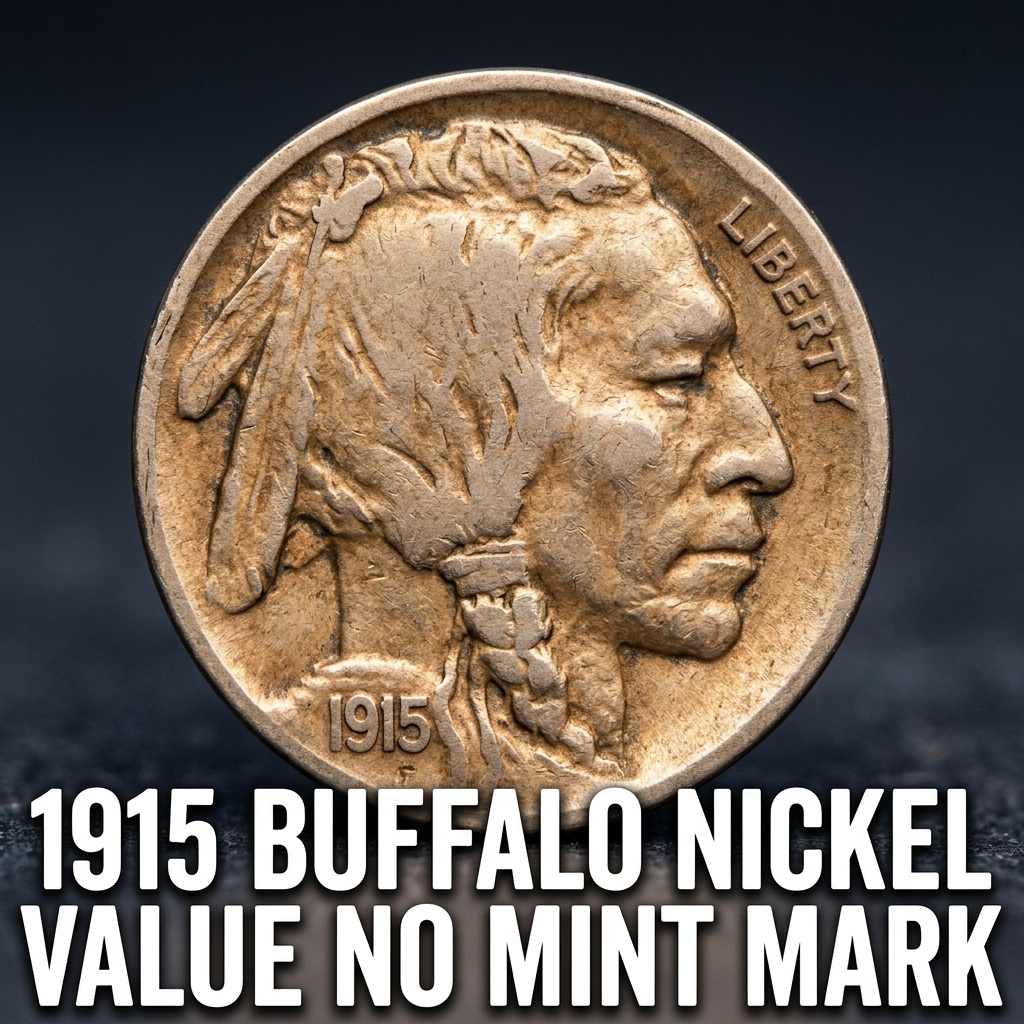
The 1915 Buffalo Nickel is worth anywhere from $15 in worn condition to over $1,200 in high-grade mint state. Finding one of these storied American coins in your pocket change or an old collection is an exciting discovery that connects you directly to the early 20th-century history of the United States.
Understanding the 1915 Buffalo Nickel Without a Mint Mark
The 1915 Buffalo Nickel without a mint mark was struck at the main United States Mint in Philadelphia. During this era, the Philadelphia Mint did not use “P” marks on its coinage, so any 1915 nickel that lacks a small letter beneath the date or on the reverse is officially a Philadelphia issue. This specific year belongs to the “Type 2” category, which means the buffalo stands on a flat line rather than a raised mound, a design change implemented in 1913 to prevent the “Five Cents” text from wearing away too quickly.
In 1915, the Philadelphia Mint produced approximately 20.9 million of these coins. While that sounds like a massive number, you must remember that these coins circulated heavily through the Great Depression and two World Wars. Many were worn down until the date became invisible, making a readable 1915 Philadelphia nickel a cherished find today. If you are unsure if your coin is authentic or need a quick identification, using a top coin identifier app can help you confirm the date and variety in seconds.
For beginners, identifying this coin is straightforward. The obverse (front) features the stoic profile of a Native American man, while the reverse (back) showcases the iconic American Bison (often called a buffalo). If there is no “D” or “S” mark under the words “Five Cents,” you have the Philadelphia version. To get a better sense of how much your specific specimen is worth, the CoinHix app provides real-time market data that accounts for current collector demand.
Evaluating the Physical Condition and Grade
When it comes to old nickels, “condition is king.” Coin collectors use a 70-point scale to determine the grade of a coin, ranging from PO-1 (Poor) to MS-70 (Mint State). A 1915 Buffalo Nickel that has been sitting in a jar for decades is likely in “Good” or “Very Good” condition. In these lower grades, the buffalo’s horn will be missing and the date might be faint, but the coin still holds value due to its silver-free copper-nickel composition and historical appeal.
If you are lucky enough to find a coin with a sharp “Full Horn” on the buffalo, the value jumps significantly. Collectors look for high-definition details in the Native American’s hair braid and the fur on the buffalo’s head. Professional grading can be expensive, so many hobbyists use the CoinHix photo-recognition feature to get a preliminary grade before deciding to send their coin to a service like PCGS or NGC.
The most valuable 1915 Philadelphia nickels are those that never entered circulation. These “Uncirculated” coins retain their original mintage luster, appearing shiny or satiny rather than dull and grey. You can check the current market trends for 1915 Buffalo Nickel mint state prices to see just how much a high-grade example can fetch at auction, where prices often climb into the four-figure range for pristine specimens.
| Condition / Grade | Estimated Market Value |
|---|---|
| Good (G-4) | $15 – $22 |
| Very Good (VG-8) | $25 – $35 |
| Fine (F-12) | $42 – $55 |
| Very Fine (VF-20) | $60 – $85 |
| Extremely Fine (EF-40) | $110 – $145 |
| About Uncirculated (AU-50) | $175 – $225 |
| Mint State (MS-63) | $350 – $450 |
| Gem Mint State (MS-65+) | $1,200+ |
Key Factors that Influence 1915 Nickel Worth
Beyond just the basic grade, several factors can influence what a dealer or collector will pay you for your 1915 Buffalo Nickel. One major factor is “eye appeal.” Does the coin have a nice, even color, or is it splotchy and scratched? Damage like rim dings, deep scratches, or signs of improper cleaning can significantly lower the price, even if the coin is otherwise fairly detailed.
Another factor is the presence of errors. While not as famous as the 1937-D Three-Legged Buffalo, the 1915 Philadelphia issue occasionally shows minor doubling or die cracks. These anomalies are highly sought after by specialists. If you are looking for more detailed 1915 nickel value data and historical auction results, checking a comprehensive price guide is essential before you attempt to sell.
Market demand also fluctuates. Buffalo Nickels are among the most popular series for American collectors, meaning there is almost always a buyer for a 1915 specimen. Whether you use CoinHix to track your inventory or browse local coin shops, staying informed about recent sales will ensure you don’t accidentally undervalue a rare piece of Americana.
How to Safely Handle and Store Your Coin
If you find a 1915 Buffalo Nickel without a mint mark, the first rule is: do not clean it! While it might be tempting to scrub off decades of dirt to make the buffalo shine, cleaning a coin actually ruins its numismatic value. Natural “patina” or toning is preferred by collectors. Scrubbing creates microscopic scratches that professional graders can spot instantly, often reducing a coin’s value by 50% or more.
Instead, handle the coin only by its edges. Oils from your skin can cause further oxidation and damage over time. To preserve the value of your find, store it in a PVC-free plastic flip or a cardboard “2×2” holder. This protects the surface from air and moisture. Proper storage ensures that when you ready to sell or pass the coin down to the next generation, it remains in the same condition as the day you found it.
Frequently Asked Questions
Q: Where is the mint mark on a 1915 Buffalo Nickel?
A: On Buffalo Nickels, the mint mark (if there is one) is located on the reverse side. Look just below the words “Five Cents” and the line the buffalo is standing on. If the area is blank, it was minted in Philadelphia.
Q: Is a dateless 1915 Buffalo Nickel worth anything?
A: Buffalo Nickels are notorious for having their dates wear off because the date was placed on a high point of the design. A dateless nickel is usually only worth about 50 cents to a dollar as a “cull” or for jewelry making, as it is impossible to prove it is a 1915 without a visible date.
Q: How can I tell if my 1915 Nickel is a “Type 1” or “Type 2”?
A: By 1915, all Buffalo Nickels were Type 2. The Type 1 design, which features the buffalo standing on a physical “mound” or “hill,” was only produced during the first few months of 1913.
Q: What is the rarest Buffalo Nickel?
A: While the 1915 Philadelphia is a great coin, it is not the rarest. The most famous rarities in the series include the 1913-S Type 2, the 1916 Double Die Obverse, and the 1937-D Three-Legged Buffalo. However, a 1915 in perfect condition is still a very high-value item.