
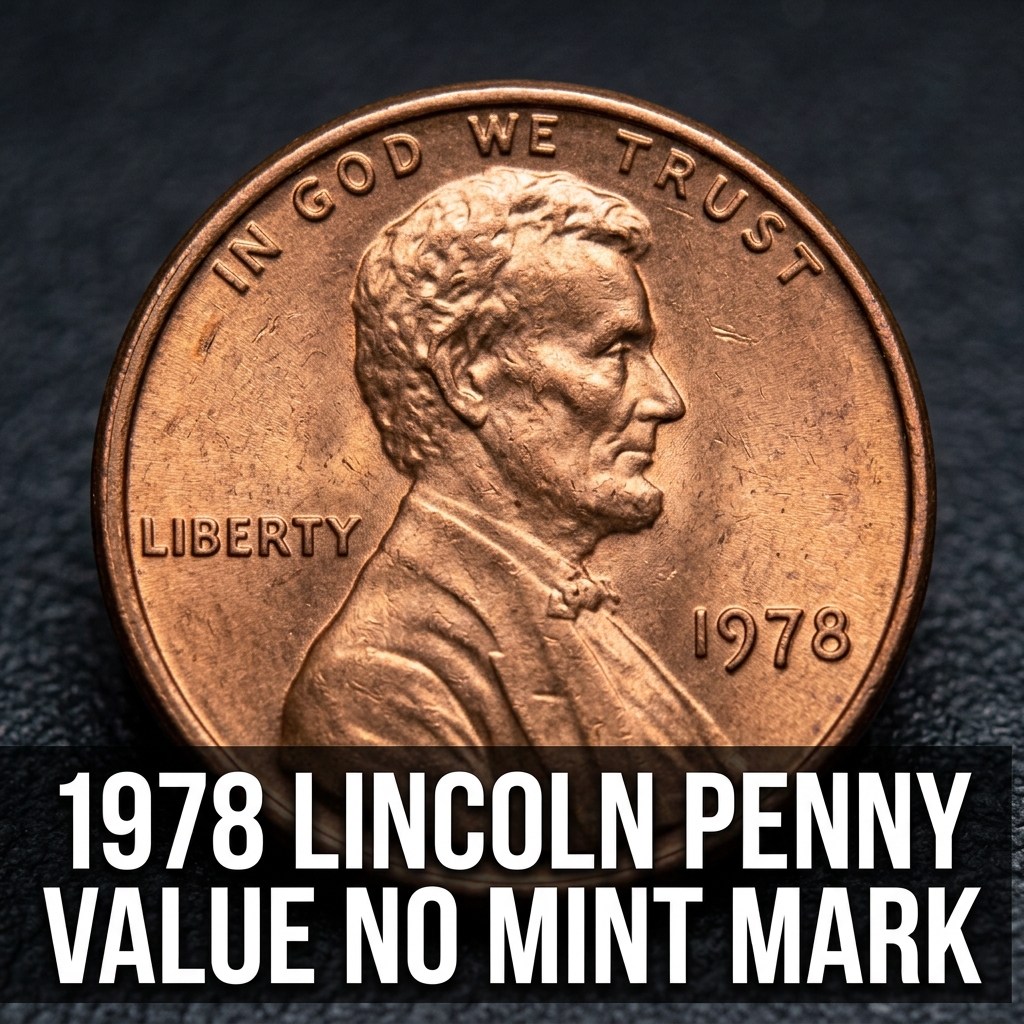
The 1978 Lincoln Penny with no mint mark is worth anywhere from $0.01 in worn condition to over $3,500 for rare high-grade specimens. If you have recently found one of these copper coins in your pocket change or an old jar, you are likely wondering if you have hit a small jackpot.
Understanding the 1978 Penny With No Mint Mark
When you look at a 1978 penny and notice there is no small letter “D” or “S” under the date, it simply means the coin was struck at the Philadelphia Mint. During this era, the Philadelphia facility did not use mint marks on the Lincoln cent. Over 5 billion of these coins were produced in 1978 alone, making them incredibly common in everyday circulation. Because so many were made, most of the coins you find in your wallet today are only worth their face value or their weight in copper.
However, “common” does not mean “worthless.” Collectors are always looking for coins that managed to survive the last four decades without getting scratched or dinged. If you aren’t sure how to tell if your coin is special, you can use a top coin identifier app to get an instant secondary opinion on the condition and potential rarity of your find. Finding a coin in “Mint State” is the key to unlocking real value.
Most people don’t realize that pre-1982 pennies are actually made of 95% copper. While a 1978 penny is legally worth one cent, its metal content is actually worth about two cents. While it is currently illegal to melt these coins down for their metal, many hoarders keep them because of this intrinsic bullion value. If you have a large hoard, using an app like CoinHix can help you track the total value of your collection as market prices fluctuate.
How Grading Affects the 1978 Lincoln Penny Value
In the world of coin collecting, condition is everything. Coins are graded on a scale from 1 to 70. A coin that has been handled by thousands of people is considered “Circulated” and usually carries no premium. However, coins that look like they just came off the printing press are called “Uncirculated” or “Mint State” (MS). A 1978 penny in MS65 condition might be worth a few dollars, but one that reaches MS67 or higher can sell for hundreds or even thousands at auction.
Color also plays a massive role in the 1978 Lincoln Penny value. Collectors categorize copper coins into three groups: Red (RD), Red-Brown (RB), and Brown (BN). A “Red” coin retains its original mint luster and looks bright orange-copper. These are the most desirable. You can check the current 1978 penny price for Red specimens to see how much of a premium these bright coins command compared to the dull brown ones found in change.
Evaluating your coin’s grade can be tricky for a beginner. You should look for sharp details in Lincoln’s hair and the lines on the wheat stalks or the Lincoln Memorial on the reverse. If the details are blurry or smooth, the coin is likely a common circulated piece. For those who want a professional-grade analysis without sending the coin away, the CoinHix app utilizes advanced image recognition to help you identify these subtle grading differences from your smartphone.
1978 No Mint Mark Penny Value Chart
To give you a better idea of what your coin might be worth, we have compiled a price guide based on the coin’s condition and color designation. Note that most pennies found in change will fall into the “Circulated” category.
| Condition / Grade | Brown (BN) Value | Red-Brown (RB) Value | Red (RD) Value |
|---|---|---|---|
| Circulated (F-AU) | $0.02 – $0.05 | N/A | N/A |
| Uncirculated (MS63) | $0.15 | $0.30 | $1.00 |
| Choice Unc (MS65) | $0.50 | $2.00 | $10.00 |
| Superb Gem (MS67) | $5.00 | $25.00 | $150.00+ |
| Record High (MS68) | N/A | N/A | $3,500+ |
Rare 1978 Penny Errors to Look For
While standard 1978 pennies are common, error coins are the “hidden treasures” that every hunter hopes to find. Errors occur when something goes wrong during the minting process. One of the most common errors for this year involves “Off-Center Strikes.” This happens when the coin blank isn’t properly aligned with the dies, resulting in a penny where part of the design is missing and a portion of the coin is blank.
Another valuable discovery is a “Double Die” error. This occurs when the die used to strike the coin has a doubled image, which is then transferred to the penny. While 1978 doesn’t have a famous major double die like 1955 or 1972, minor doubling on the date or the lettering can still increase the coin’s value to $20 or $50. You should check the 1978 penny error values and auction records to see what specific mistakes have sold for recently.
Finally, look out for “Die Cracks” or “BIE Errors.” A die crack looks like a raised line of metal on the surface of the coin, caused by the minting die breaking under pressure. A BIE error is a specific type of die crack that occurs between the letters “B” and “E” in the word “LIBERTY,” making it look like there is an extra “I.” These are popular among niche collectors. Tools like CoinHix can help you zoom in on high-resolution photos of your coins to spot these tiny imperfections.
Summary for the Everyday Coin Hunter
If you found a 1978 Lincoln penny in your pocket, don’t quit your day job just yet. For 99% of people, that penny is worth about two cents in copper metal value. However, if that penny looks like it was made yesterday—with a bright red luster and no scratches—it is worth pulling aside. High-grade specimens are rare and highly sought after by registry set collectors.
Always remember to handle potentially valuable coins by their edges. The oils from your fingers can smudge the “Red” luster and turn a valuable MS67 coin into a common brown one in a matter of months. If you think you’ve found an error or a high-grade 1978 penny, consider putting it in a protective flip and using a digital identification tool to verify its potential before spending money on professional third-party grading.
Frequently Asked Questions
Q: Is a 1978 penny with no mint mark rare?
A: No, it is not rare. The lack of a mint mark means it was minted in Philadelphia, which produced over 5.5 billion of these coins. They are very common in circulation.
Q: What is the highest price ever paid for a 1978 penny?
A: A 1978 Lincoln Penny graded MS68 Red by PCGS sold for over $4,000 at auction. However, such high grades are extremely rare for this year.
Q: How can I tell if my 1978 penny is copper or zinc?
A: All 1978 pennies are made of 95% copper. The US Mint did not switch to the copper-plated zinc composition until mid-1982.
Q: Should I clean my 1978 penny to make it look “Red”?
A: Never clean your coins! Cleaning as a coin-owner actually destroys the numismatic value. Collectors prefer a natural brown coin over one that has been chemically cleaned or scrubbed.