
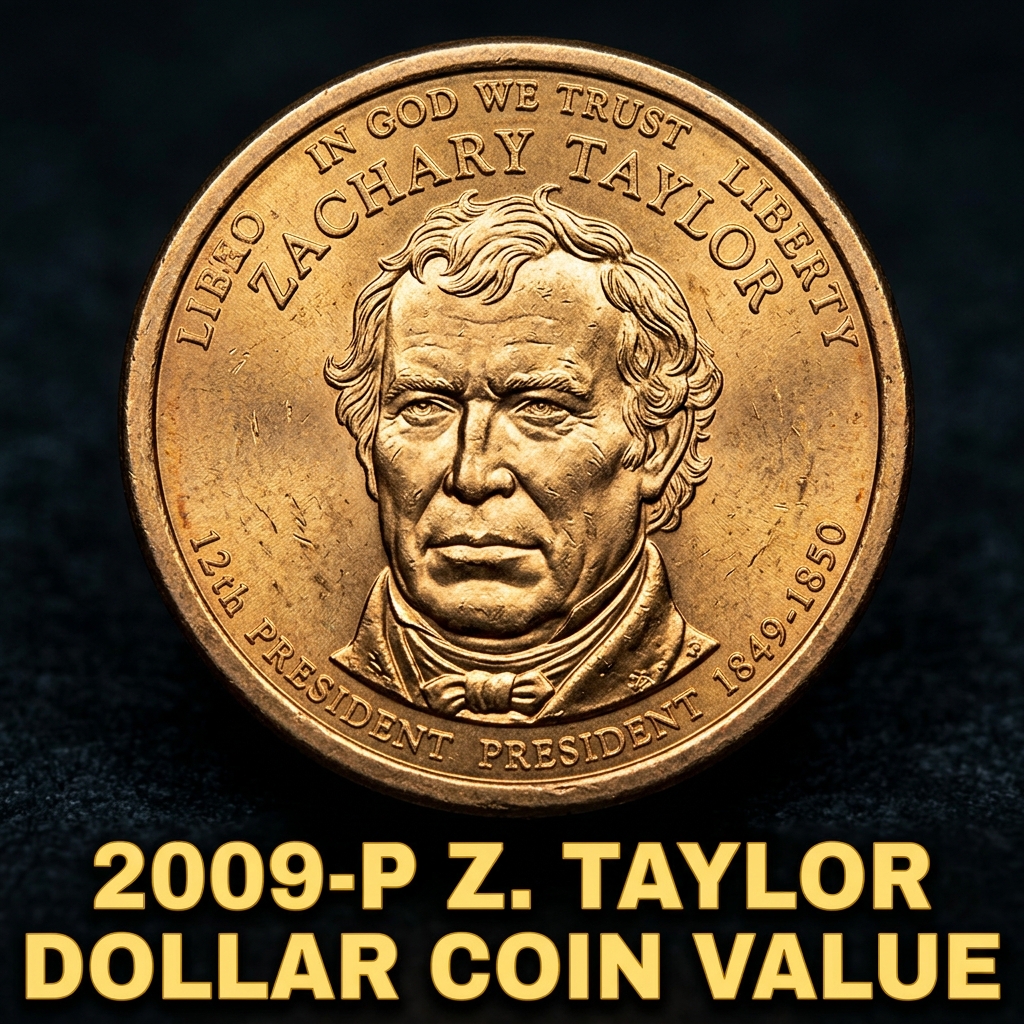
The 2009-P Zachary Taylor Dollar is worth anywhere from $1 in circulated condition to over $150 for high-grade specimens. Finding one of these golden-colored coins in your change can be exciting, but understanding the difference between a common spender and a collector’s prize is the key to knowing what you actually have.
History of the 2009 P Zachary Taylor Presidential Dollar
The Presidential $1 Coin Program was a massive undertaking by the United States Mint to honor our nation’s leaders in chronological order. Released in 2009, the Zachary Taylor dollar honors the 12th President of the United States. Taylor, a war hero known as “Old Rough and Ready,” served a brief term from 1849 until his untimely death in 1850.
Because these coins are part of a modern series, millions were minted at the Philadelphia facility, which is what the “P” mint mark represents. If you are ever unsure about the specific mint or condition of your find, using a top coin identifier app can quickly clarify what you are looking at. Most people encounter these in “bank-wrapped” rolls or as change from vending machines.
While these coins look like gold, they are actually composed of a copper core with a manganese brass cladding. This gives them their distinct golden hue, which unfortunately tends to dull or tarnish quickly when handled. Because they were minted in such large quantities, most examples found in your pocket today are only worth their face value of $1. However, collectors pay a premium for those that remain in pristine, uncirculated condition.
Determining the 2009 Zachary Taylor Dollar Value
To figure out the market price, we look at the “grade” or condition of the coin. Most coins found in circulation show signs of wear, such as scratches and loss of luster. These are graded as “Circulated” and generally won’t fetch more than a dollar. To find a truly valuable piece, you need to look for “Mint State” (MS) coins that haven’t been marred by the oily fingers of the general public.
The CoinHix app is an excellent resource for real-time market data if you want to see what current auctions are yielding. For those specifically looking for professional grading data, you should check the latest 2009-P Zachary Taylor dollar auction records to see how much people are paying for MS66 or MS67 examples. Higher grades are significantly rarer because the oversized “golden” planchets were prone to getting dinged during the high-speed minting process.
Below is a breakdown of the estimated values based on the most common grades found today. Remember that these prices reflect coins that have been professionally certified by agencies like PCGS or NGC.
| Condition / Grade | Estimated Value |
|---|---|
| Circulated (F-AU) | $1.00 |
| Mint State 63 (Uncirculated) | $2.50 – $4.00 |
| Mint State 65 (Gem Uncirculated) | $10.00 – $15.00 |
| Mint State 67 (Superb Gem) | $80.00 – $150.00+ |
Edge Lettering and Error Varieties
One of the most unique aspects of the 2009 P Zachary Taylor Dollar is the edge lettering. Unlike traditional coins where the date and mint mark are on the face, the Presidential series moved this information to the edge (the rim) of the coin. This includes the date, the “P” mint mark, and the mottos “E Pluribus Unum” and “In God We Trust.”
Many collectors search for “Position A” or “Position B” variations, which refers to the orientation of the lettering when the coin is placed heads-up. While these are common, some rare errors can occur during this edge-incusing process. If you find a coin where the edge lettering is missing entirely, you might have a “Smooth Edge” error.
Given the complexity of modern minting, you might want to review the full 2009 Presidential Dollar price guide to see how the Taylor dollar stacks up against others from the same year, like the Harrison or Tyler dollars. Using tools like CoinHix can help you distinguish between a genuine mint error and mechanical damage that happened after the coin left the mint.
Identifying Mint State Taylor Dollars
If you want to get the most money for your coin, it essentially needs to look like it was just struck. In the numismatic world, “luster” is everything. When you tilt the coin under a light, an uncirculated 2009-P Taylor dollar should have a “cartwheel” effect where light revolves around the surface. If the surface looks flat, dull, or greyish, it has likely been in circulation too long to hold a high premium.
Look specifically at President Taylor’s cheek and the high points of his hair. These are the first places to show wear. On the reverse, check the Statue of Liberty’s rays and her robe. If these areas are sharp and show no signs of flattening, you should put the coin in a protective flip immediately to preserve its condition.
For everyday Americans, the best way to keep track of a growing collection is the CoinHix mobile app. It allows you to log your finds and compare your coin’s appearance to high-resolution images of top-tier grades. This helps you decide if a coin is worth the $20+ fee to have it professionally graded.
Frequently Asked Questions
Q: Is the 2009 Zachary Taylor dollar made of real gold?
A: No, these coins do not contain any gold. They are made of a copper core with a coating of manganese brass, which gives them their gold-like color.
Q: Where is the mint mark on a 2009 P Taylor dollar?
A: The mint mark is not on the front or back of the coin. You must look at the edge (the rim) of the coin to see the “P” for Philadelphia, along with the date and mottos.
Q: Are there any “Missing Edge Lettering” errors for this coin?
A: While very rare, some Zachary Taylor dollars were released without the edge lettering. If the edge is completely smooth and does not have the date or mint mark, it could be a valuable error worth several hundred dollars.
Q: Can I spend this coin at a grocery store?
A: Yes, these are legal tender. They are worth exactly $1 at any business. However, it is always worth checking the condition first to see if it has collector value above its face worth.