
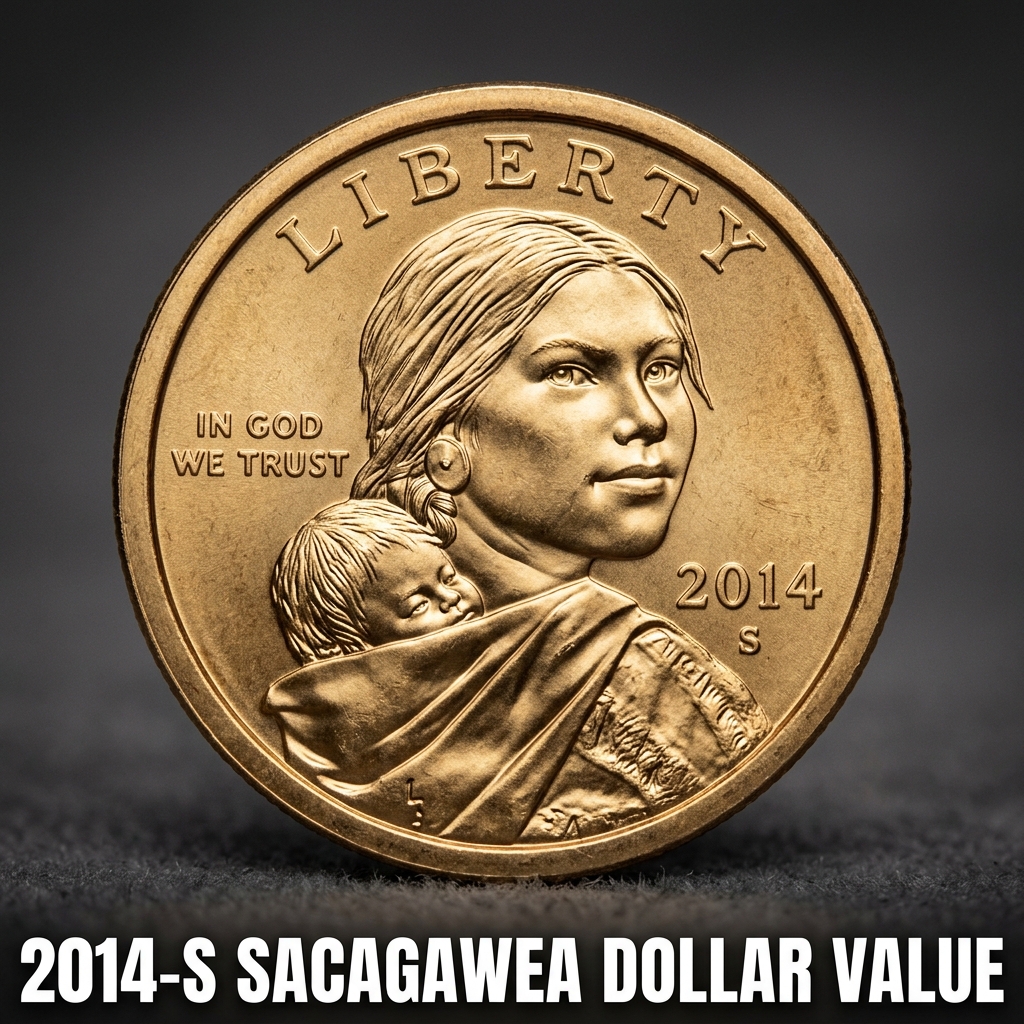
The 2014 S Sacagawea Dollar is worth anywhere from $3 in standard proof condition to over $100 for high-grade Deep Cameo specimens. While these golden dollars are common in pocket change, the “S” mint mark version holds a special place in the hearts of glass-case collectors and casual finders alike.
Building a coin collection often starts with a single discovery in a jar of change or an old desk drawer. If you have recently come across a shiny golden coin featuring a Native American woman and a hospitality theme on the reverse, you might be holding a piece of modern numismatic history. To get an instant valuation of your finds, using a top coin identifier app can save you hours of manual research. Tools like the CoinHix app allow you to snap a photo and immediately see if your coin is a common circulation strike or a valuable collector’s proof from the San Francisco Mint.
Understanding the 2014 S Native American Dollar Mintage
The 2014 edition of the Sacagawea series is officially part of the Native American $1 Coin Program. While the obverse (front) continues to feature the iconic portrait of Sacagawea and her infant son, Jean Baptiste Charbonneau, the reverse (back) changes annually. The 2014 design commemorates the hospitality shown by Native Americans during the Lewis and Clark Expedition. It depicts a Native American man offering a pipe while his wife offers a basket of food.
The “S” mint mark indicates the coin was struck at the San Francisco Mint. Unlike the “P” (Philadelphia) or “D” (Denver) coins, which were produced for general circulation and government bags, the S-mint coins were specifically struck as “Proofs.” Proof coins are made using special polished dies and planchets, resulting in a mirror-like finish and frosted details. Because these were never intended to be spent at a grocery store, finding one in actual circulation is rare, though it does happen when someone spends a collector’s set by mistake.
Determining the Market Value of Your 2014 S Proof Dollar
When assessing the price, condition is everything. Most 2014 S Sacagawea Dollars found today remain in their original plastic lenses from the U.S. Mint. In this state, they generally trade for a few dollars. However, the market fluctuates based on the “Deep Cameo” (DCAM) quality, where the contrast between the shiny fields and the white frosted portraits is exceptionally sharp.
For many hobbyists, the easiest way to track these shifts is by checking a comprehensive database of 2014 Sacagawea dollar price records. This helps you distinguish between a coin that is simply “shiny” and one that is “investment grade.” If you find a specimen that is flawless under a magnifying glass, it could be worth significantly more to a registry set collector. Professional grading by services like PCGS or NGC can further validate this value.
Comparison Table for 2014 Sacagawea Dollar Values
To help you understand the landscape of this specific year, here is a breakdown of the estimated market values for the different mint marks produced in 2014. Note that while S-mints are proofs, the P and D mints also have value in high uncirculated conditions.
| Mint Mark & Type | Condition / Grade | Estimated Value |
|---|---|---|
| 2014-S Proof | PR 65 (Standard) | $3.00 – $5.00 |
| 2014-S Proof | PR 70 DCAM (Perfect) | $40.00 – $110.00 |
| 2014-P Uncirculated | MS 65 | $2.50 – $4.00 |
| 2014-D Uncirculated | MS 65 | $2.50 – $4.00 |
What Makes the 2014 S Sacagawea Dollar Special
What sets the 2014 S apart from your average dollar coin is the “Proof” manufacturing process. These coins are struck at least twice with higher pressure to ensure every fine detail of the Native American hospitality theme is captured. If you look at the edge of the coin, you will see the year, the “S” mint mark, and the “E Pluribus Unum” motto incused (stamped into) the metal. This edge-incused lettering is a hallmark of the modern dollar series.
Many people use the CoinHix app to zoom in on these edge inscriptions. It is a common place for “errors” to occur, though no major edge errors have been widely reported for the 2014 S specifically. Still, checking the latest 2014 Sacagawea dollar valuation data is essential because the market for “Golden Dollars” often sees spikes when new collectors enter the hobby and look for pristine Proof sets to complete their albums.
How to Care for and Protect Your San Francisco Proofs
If you are lucky enough to own a 2014 S Sacagawea Dollar, handling it properly is the key to maintaining its value. Because the “fields” (the flat background parts) are mirrors, even a single fingerprint can cause permanent damage. The oils from your skin contain acids that can eat into the copper-manganese-brass finish over time.
Always hold your coins by the edges, or better yet, wear lint-free cotton gloves. If your coin is already in a protective plastic flip or the original Mint lens, leave it there! Removing a proof coin from its case almost always results in a lower grade. If you’re unsure if yours is worth the cost of professional grading, let CoinHix give you a preliminary estimate. A high-grade PR70 specimen is a rarity that collectors will pay a premium for, whereas a common PR68 is much more affordable.
2014 S Sacagawea Dollar Frequently Asked Questions
Q: Is the 2014 S Sacagawea Dollar made of real gold?
A: No, despite their “Golden Dollar” nickname, these coins contain 0% gold. They are made of a pure copper core clad in an alloy of copper, zinc, manganese, and nickel, which gives them their distinct yellow color.
Q: Can I spend a 2014 S Proof coin at the store?
A: Technically, yes. It is legal tender worth exactly one dollar. However, doing so would be a mistake, as the coin is worth at least 3 to 10 times its face value to a collector, even in a somewhat worn state.
Q: Where is the mint mark on the 2014 Sacagawea Dollar?
A: Unlike older American coins where the mint mark is on the front or back, the 2014 $1 coin has its mint mark (“S”, “P”, or “D”) inscribed on the edge of the coin. You have to turn it sideways to see it.
Q: Are there any known errors for the 2014 S Dollar?
A: While there are no famous “major” errors like the 2000-P “Cheerios” dollar, collectors always look for minor doubling on the obverse or reverse. Using a high-resolution coin app is the best way to spot these tiny variations.