
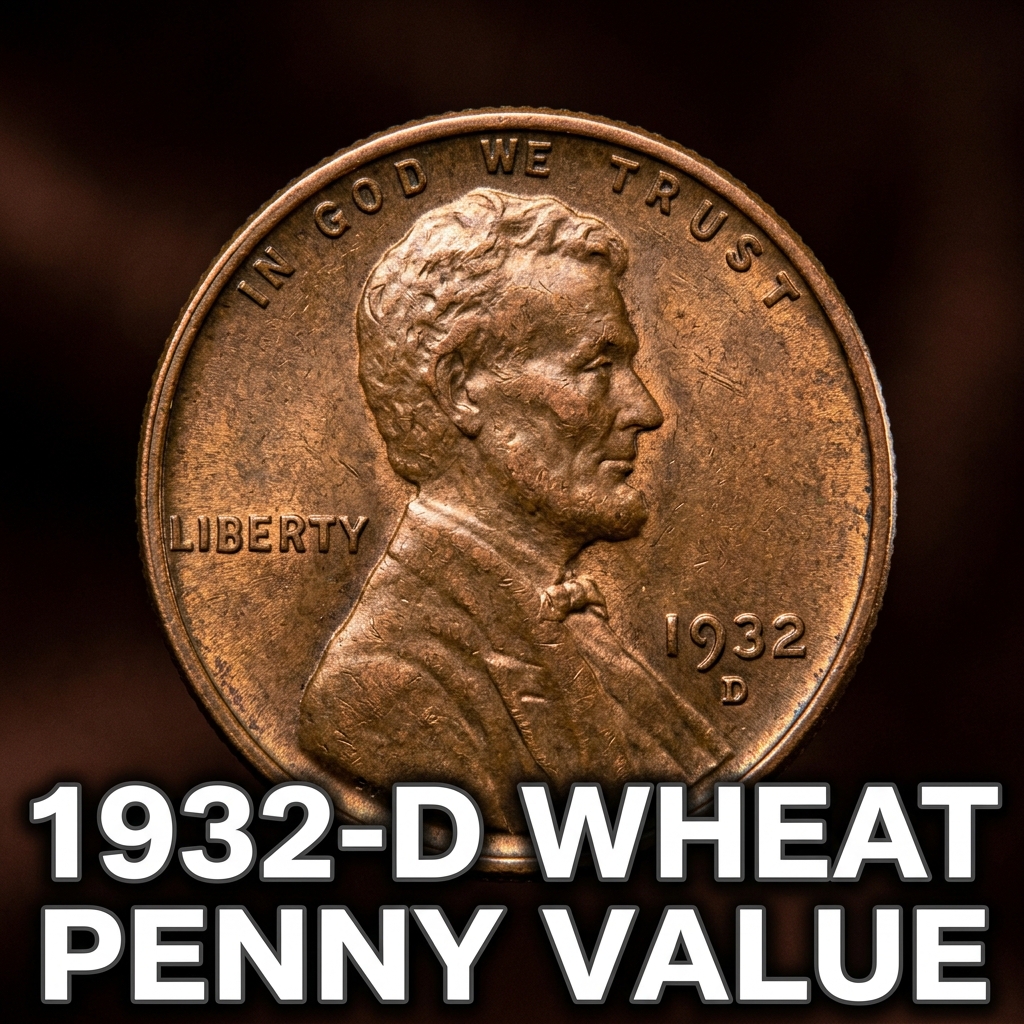
The 1932-D Wheat Penny is worth anywhere from $1.50 in worn condition to over $500 in high-grade mint state. As a semi-key date in the Lincoln cent series, this coin is a prize for everyday collectors who discover a piece of history in their spare change or old jars.
Understanding the History and Rarity of the 1932-D Lincoln Cent
The year 1932 was a difficult time for the United States as the Great Depression reached its peak. Because economic activity was so low, the demand for new coinage plummeted. Consequently, the Denver Mint produced only 10.5 million pennies that year. While that might sound like a large number, it is actually quite low compared to modern production runs that reach into the billions. This lower mintage makes the 1932-D a “semi-key” date, meaning it is harder to find than your average wheat penny but not as impossible to locate as the famous 1909-S VDB.
For those who have recently inherited a collection or stumbled upon an old coin, using a top coin identifier app can quickly confirm if your penny features that crucial “D” mint mark. The Denver Mint’s production in 1932 was significantly lower than the Philadelphia Mint’s production of later years, which is why even a heavily circulated example carries a premium over its one-cent face value. Many collectors use the CoinHix app to keep an inventory of these Depression-era finds.
When you look at your coin, the “D” mint mark is located just below the date “1932” on the obverse (the side with Abraham Lincoln). If there is no letter there, it was minted in Philadelphia. While Philadelphia 1932 pennies are also collectible, the Denver version is generally more sought after by numismatists looking to complete their Lincoln cent sets.
Current Market Value and Pricing Guide for 1932-D Pennies
The value of a 1932-D Wheat Penny depends primarily on its “grade” or state of preservation. Most coins found in circulation today will fall into the “Good” to “Fine” categories. These coins show significant wear, with Lincoln’s hair details smoothed out and the wheat stalks on the reverse looking flat. Even in this condition, the coin is a treasure. However, if you are lucky enough to find one that still has its original copper orange glow, the 1932-D penny value increases dramatically as it enters the “Uncirculated” territory.
Professional grading services look for “Red” (RD) designations, which indicate the coin has retained at least 95% of its original mint color. A 1932-D in MS65 Red condition is a true rarity and can fetch several hundred dollars at auction. For everyday Americans, checking these details is easier with tools like CoinHix, which provides visual guides to help you distinguish between a brown, circulated coin and a red, uncirculated gem.
| Condition / Grade | Estimated Market Value |
|---|---|
| Good (G-4) | $1.50 – $2.50 |
| Fine (F-12) | $4.00 – $6.00 |
| Extremely Fine (XF-40) | $15.00 – $25.00 |
| About Uncirculated (AU-50) | $35.00 – $55.00 |
| Mint State (MS-63 Brown) | $90.00 – $120.00 |
| Mint State (MS-65 Red) | $450.00 – $650.00+ |
How to Identify a Genuine 1932-D Wheat Penny
Identification is the first step toward determining if your coin is a payday or just a penny. The 1932-D is often faked or altered because of its value. Scammers sometimes take a common 1932 Philadelphia penny and glue a “D” mint mark onto it. To verify yours is authentic, look closely at the mint mark under a magnifying glass. It should look like it is part of the coin, not sitting on top of the surface. The shape of the “D” in 1932 was also very specific; it should have a clear, crisp center.
Beyond the mint mark, you want to examine the overall strike. Denver pennies of this era sometimes have a slightly weaker strike than those from Philadelphia, but the word “LIBERTY” and the date should still be legible. If you are unsure, the CoinHix app allows you to upload photos and compare your coin against high-resolution images of verified genuine specimens.
Before you consider selling, ensure you have checked the 1932-D penny market data for red uncirculated grades, as these are the most volatile in price. A small scratch or an fingerprint “oil stain” on a high-grade coin can reduce the price by half, so handle your pennies by the edges only.
Factors That Influence the Value of Your 1932 Denver Penny
Several variables play into why one 1932-D penny sells for $2 and another sells for $500. The most significant factor is the color. Copper oxidizes over time, turning from a bright red to a deep chocolate brown. In the world of coin collecting, “Red” (RD) is the most valuable, followed by “Red-Brown” (RB), and finally “Brown” (BN). Most 1932-D pennies found today are BN.
Another factor is “eye appeal.” Even a worn coin can be valuable if it worn evenly and doesn’t have ugly scratches, holes, or corrosion. Collectors prefer a smooth, chocolate-brown surface over a coin that has green “PVC” damage or dark spots. If your coin looks “cleaned” (unnaturally shiny or covered in tiny hairline scratches from scrubbing), its value will drop significantly. Never clean your coins, as it removes the original surface that collectors crave.
Finally, market demand fluctuates. During times of economic uncertainty, tangible assets like rare coins often see an increase in interest. Keeping track of these trends helps you decide whether to sell now or hold onto your 1932-D Wheat Penny for the long term.
Frequently Asked Questions About the 1932-D Penny
Q: Is the 1932-D Wheat Penny considered rare?
A: It is considered a “semi-key” date. While it is not as rare as the 1909-S VDB or the 1914-D, its mintage of 10.5 million is much lower than the hundreds of millions produced in other years, making it a valuable find for the average person.
Q: Where is the mint mark on a 1932-D penny?
A: The mint mark is a small “D” located on the front (obverse) of the coin, right underneath the date 1932. If there is no letter, it was minted in Philadelphia.
Q: How can I tell if my 1932-D penny is a proof?
A: The Denver Mint did not produce proof coins in 1932. All 1932-D pennies are business strikes intended for circulation. Proof Lincoln cents from that era are extremely rare and were generally only minted in Philadelphia.
Q: What should I do if I find a 1932-D Wheat Penny?
A: First, place it in a protective holder or a soft envelope to prevent further wear. Do not clean it. Use a valuation app to get an initial idea of its grade, and if it appears to be in “Mint State” (uncirculated), consider having it professionally graded by a service like PCGS or NGC.