
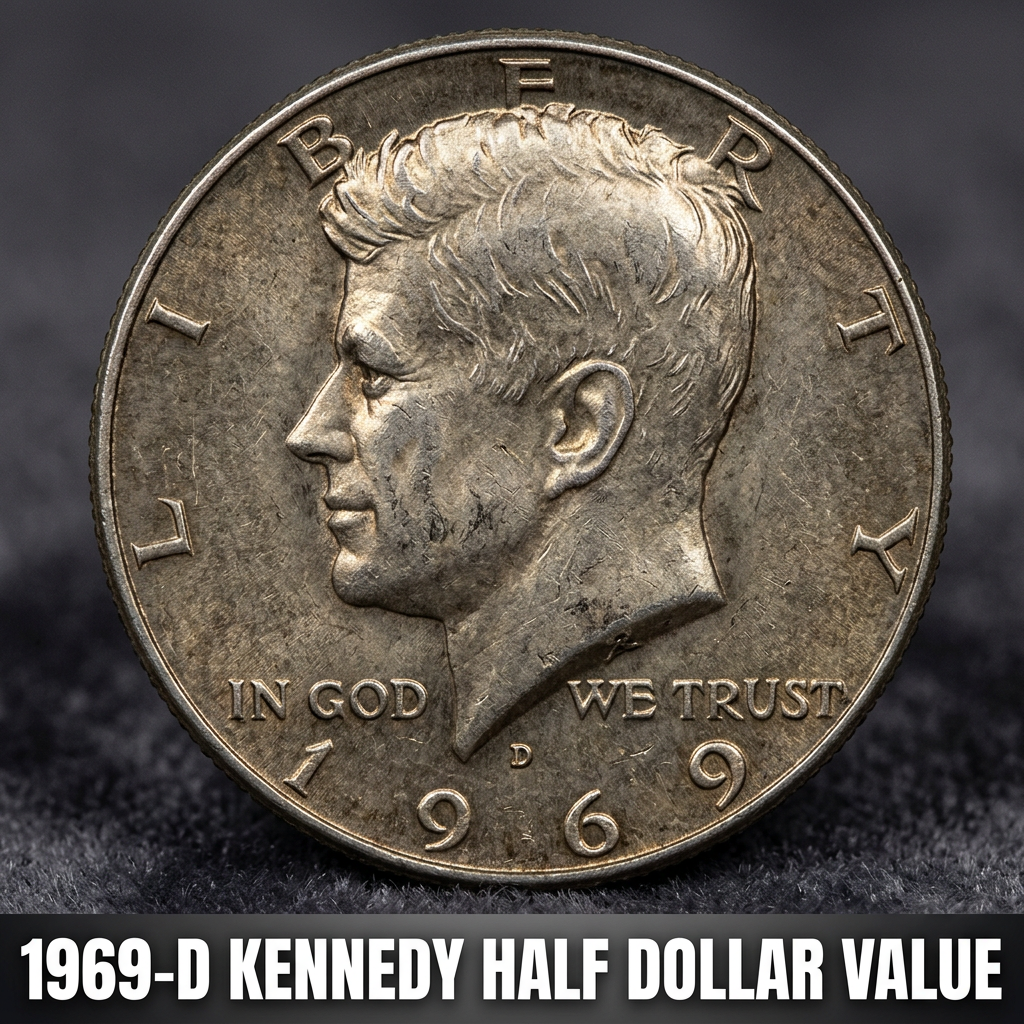
The 1969-D Kennedy Half Dollar is worth anywhere from $8 in circulated condition to over $1,500 in high mint state grades. While you might expect a late 60s coin to be made of cheap nickel and copper, this specific Denver-minted coin actually contains a significant amount of real silver, making it a “treasure in your pocket.”
What Makes the 1969 D Kennedy Half Dollar Special
If you’ve just found a shiny half dollar from 1969 with a small “D” on the obverse, you aren’t just holding a piece of fifty-cent pocket change. Unlike the quarters and dimes of that era, which had already switched to base metals, the 1969-D Kennedy Half Dollar is part of the “silver clad” era. These coins were minted with an inner core of 21% silver and an outer layer of 80% silver, bringing the total silver content to 40%.
For many everyday Americans, finding one of these in an old jar or a inherited collection is an exciting introduction to the world of numismatics. If you are unsure if your coin is a silver variety or the later copper-nickel version, using a top coin identifier app can help you distinguish the subtle luster of silver from common clad. Identifying these coins early is key to ensuring you don’t accidentally spend them at face value.
Many collectors use tools like CoinHix to keep track of their finds. Since the silver melt value alone is often worth ten times the face value of the coin, knowing exactly what you have is the first step to making a profit. Even in worn condition, a 1969-D is a valuable asset because of its precious metal content.
Current Market Values for the 1969 D Kennedy Half Dollar
The value of your 1969-D half dollar is primarily determined by its condition, or “grade.” Most coins found in circulation will be worth their weight in silver. However, if a coin was tucked away in a bank roll and never touched, its value can skyrocket. Professionals use a scale from 1 to 70 to grade coins, where 60 through 70 represents “Mint State” (MS) or uncirculated condition.
When looking at the 1969-D Kennedy Half Dollar MS price data, you will notice that even a single point of difference in grade can equal hundreds of dollars in value. For example, an MS63 coin might sell for $15, while an MS67 coin can fetch several hundred dollars at auction.
| Condition / Grade | Estimated Value Range |
|---|---|
| Circulated (Good to About Uncirculated) | $8.00 – $12.00 |
| Uncirculated (MS60 – MS63) | $15.00 – $35.00 |
| Choice Uncirculated (MS65) | $65.00 – $90.00 |
| Superb Gem (MS67) | $500.00 – $1,500.00+ |
How to Identify the Mint Mark and Silver Content
To find out where your coin was made, look closely at the front (obverse) of the coin. Just above the date “1969,” you will see a small letter. The “D” stands for the Denver Mint. In 1969, the Denver Mint was the only facility that produced business-strike Kennedy Half Dollars for general circulation. If your coin has an “S” mint mark, it was likely part of a special Proof set from San Francisco.
If you don’t see a mint mark at all, it’s possible the coin is heavily worn, but all 1969 half dollars intended for circulation should have that Denver “D.” You can verify the specifics of your coin by checking a comprehensive 1969 half dollar price guide which outlines the differences between Denver strikes and San Francisco proofs.
Another way to check for silver is the “Sound Test.” If you gently tap a 40% silver coin against a hard surface, it will produce a high-pitched, melodic “ring.” A modern copper-nickel coin will produce a dull “thud.” Using the CoinHix app can also provide you with historical auction data so you can see what similar coins have sold for recently.
Key Errors and Varieties to Look For
While most 1969-D Kennedy Half Dollars are valued based on their silver content and condition, keep an eye out for mint errors. Errors can turn a common $10 coin into a centerpiece for a collection worth thousands. Some common errors to look for include “clipped planchets,” where a piece of the coin is missing, or “off-center strikes,” where the image is not centered on the metal disc.
The “Doubled Die” is another popular variety. This happens when the die used to stamp the coin has a faint second image, causing letters or numbers to look blurry or doubled. While no major doubled die was officially recognized for the 1969-D in the same way as the 1964 or 1974-D, minor varieties still exist that could intrigue specialized collectors.
The best way to spot these errors is through high-resolution photography. Many users of CoinHix upload photos of their coins to get community feedback or expert opinions on potential errors. Even a small “re-punched mint mark” (where the D seems to be stamped twice) can add a premium to the coin’s value.
Why the 1969 D Kennedy Half Dollar Values Are Rising
The value of the 1969-D Kennedy Half Dollar is influenced by two main factors: the spot price of silver and the demand from coin collectors. Because this coin contains 0.1479 troy ounces of pure silver, its minimum value fluctuates daily based on the global commodities market. When silver prices go up, the value of your 1969 half dollar goes up with it.
Additionally, we are seeing a resurgence in interest for “Kennedy” memorabilia. As the 60th anniversary of the Kennedy Half Dollar series approaches, more beginners are starting to collect these coins. This increased demand makes it harder to find high-grade specimens.
If you are thinking about selling your coin, it is important to avoid cleaning it. Many people think they are helping by polishing their old coins, but this actually removes a microscopic layer of metal and destroys the coin’s numismatic value. A “dirty” coin in original condition is almost always worth more than a “shiny” coin that has been chemically cleaned.
Frequently Asked Questions
Q: How can I tell if my 1969 Kennedy Half Dollar is 40% silver?
A: Look at the edge of the coin. A 40% silver coin will usually have a solid silver-colored edge, or a faint trace of copper-colored line. If the edge has a very distinct dark copper stripe, it might be a later date, but all 1969-D half dollars were minted as 40% silver “sandwiches.”
Q: Where is the mint mark on a 1969 Kennedy Half Dollar?
A: The mint mark on a 1969-D is located on the front (obverse) of the coin, just above the “9” in the date 1969. You will see a small “D” reflecting the Denver Mint.
Q: Should I get my 1969-D Kennedy Half Dollar professionally graded?
A: Professional grading (by companies like PCGS or NGC) usually costs $20-$50 per coin. It is only worth it if your coin is in exceptional, “uncirculated” condition without many scratches. If the coin has been sitting in a pocket or a jar, it’s best to keep it in a simple coin flip.
Q: Can I find a 1969-D Half Dollar in my change today?
A: It is rare but possible! Most of these were pulled out of circulation by banks and savvy collectors in the 1970s because of their silver content. Occasionally, someone will unknowingly spend an old collection, making “coin roll hunting” at the bank a popular hobby for finding silver.