
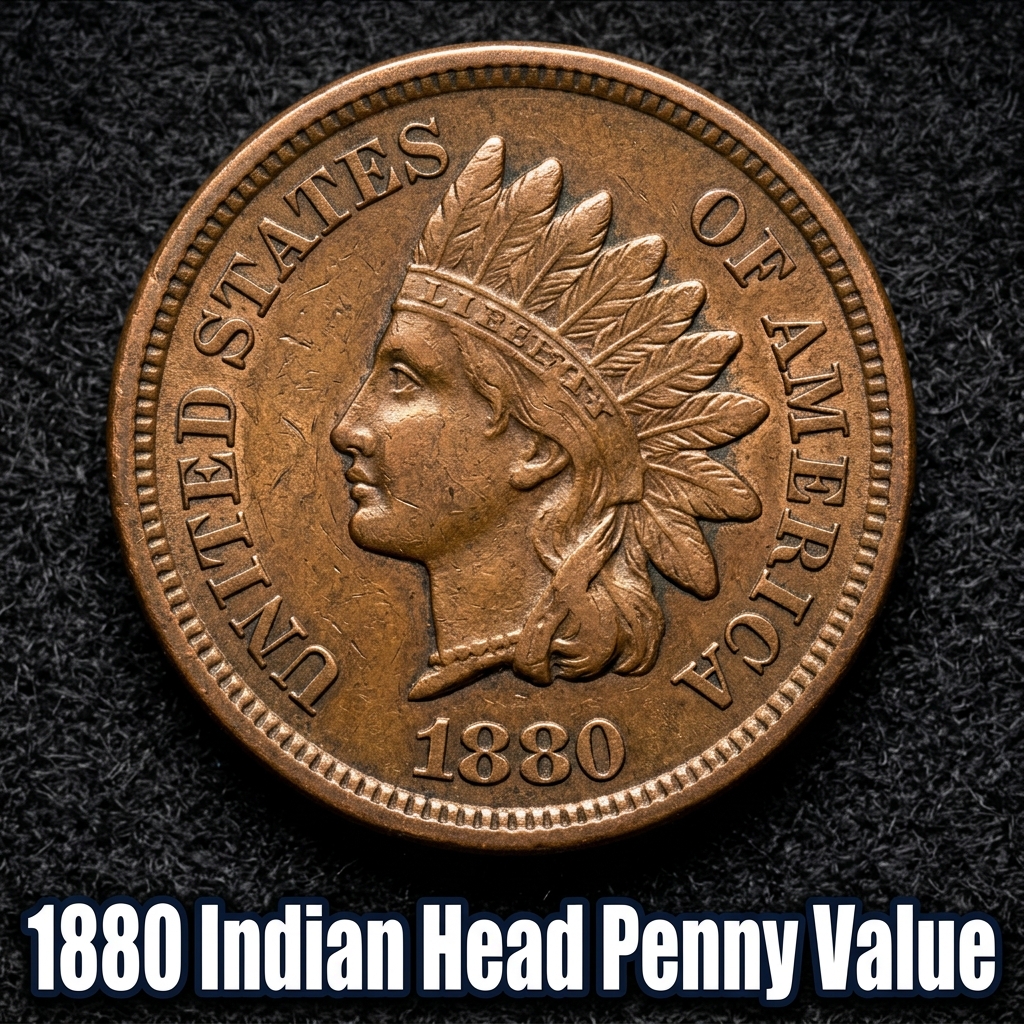
The 1880 Indian Head Penny is worth anywhere from $4 in worn condition to over $900 in pristine mint state. If you have recently discovered one of these copper relics in a late relative’s collection or while metal detecting, you are holding a fascinating piece of late 19th-century American history.
Determining the Current Market Value of Your 1880 Penny
Finding an old coin can spark instant curiosity, but before you assume you have struck gold, it is important to understand the factors that dictate the market price. The 1880 Indian Head Penny is not considered a rare date, as the Philadelphia Mint produced nearly 39 million of them. However, because most of these coins circulated heavily during the Gilded Age, finding one in high grade is a challenge for collectors today. Using a top coin identifier app can help you get an instant estimate of the condition and potential value of your specific coin.
For most casual finders, your coin will likely fall into the “Good” to “Fine” categories. In these conditions, the coin shows significant wear, and the word “LIBERTY” on the headband might be faint or completely missing. While these won’t make you rich, they are still worth hundreds of times their original face value. If you want a more precise professional look, the CoinHix app allows you to compare your coin against high-resolution images of graded specimens to see where yours fits in the spectrum.
When evaluating your coin, pay close attention to the details of the feathers and the clarity of the shield on the reverse side. Coins that have survived without scratches, “cleaning” damage, or heavy corrosion are the ones that local coin shops and online auction bidders compete for. Even a slight difference in the amount of detail visible on the Indian’s hair can mean a $10 to $20 jump in price.
Price Guide for 1880 Indian Head Cents
The following table provides a realistic look at what collectors are paying for the 1880 Indian Head Penny based on its physical condition. Keep in mind that “Red” (RD) coins remain in their original copper color and are the most valuable, while “Brown” (BN) coins have oxidized over time.
| Condition / Grade | Estimated Value (USD) |
|---|---|
| Good (G-4) | $4.00 – $6.00 |
| Fine (F-12) | $10.00 – $14.00 |
| Extremely Fine (EF-40) | $35.00 – $45.00 |
| Uncirculated (MS-60 Brown) | $85.00 – $110.00 |
| Choice Uncirculated (MS-63 Red-Brown) | $200.00 – $320.00 |
| Gem Uncirculated (MS-65 Red) | $900.00+ |
Identifying Rare Varieties and the 1880/7 Overdate
One of the most exciting aspects of the 1880 Indian Head Penny is the existence of the “80 over 79” or “0 over 9” overdate variety. During the late 19th century, mint workers would sometimes reuse dies from the previous year to save money. If you look closely at the date with a magnifying glass, you might see the remnants of a “7” underneath the final “0.”
This variety is significantly more valuable than the standard strike. While a normal 1880 penny in average condition might fetch $5, an overdate variety can easily command $50 or more even in lower grades. Many hobbyists use tools like CoinHix to zoom in on these tiny die markers that are invisible to the naked eye. If you think you see a double line or an extra digit, it is worth consulting a professional or a high-end price guide.
Beyond errors, the color of the copper plays a massive role in the 1880 Indian Head Penny auction records and pricing for top-tier specimens. Coins that still look like they just came off the press—showing a bright, lustrous orange-red glow—are highly sought after. Most pennies found today are a dark chocolate brown, which is perfectly normal for 140-year-old copper but places them in a lower price bracket.
Comparing the 1880 Penny to Other Dates
If you have a handful of old cents, you might notice that some years are worth much more than others. For example, while the 1880 is relatively common, earlier dates like the 1877 are the “holy grail” for collectors. However, the late 1880s and 1890s saw a massive increase in production. You can learn about how these values fluctuate by checking out the 1898 Indian Head Penny value and rarity guide to see the differences in market demand.
The 1880 date sits in a “sweet spot” for many collectors. It is old enough to feel truly antique, predating the turn of the century, but accessible enough that a beginner can afford to buy a beautiful specimen. This steady demand ensures that your 1880 penny will always have a buyer if it is in decent shape.
Never attempt to “clean” your penny with soap, vinegar, or metal polish. This is a common mistake made by beginners who want to make the coin look shiny. In the world of numismatics, cleaning a coin actually destroys its value. Collectors prefer the natural patina and wear that comes with age. If you are unsure of how to handle your find, the CoinHix app provides excellent resources on proper coin preservation and storage.
Summary of the 1880 Indian Head Penny
Owning an 1880 Indian Head Penny is like holding a piece of the post-Civil War American expansion. Whether it’s worth $5 or $500, the historical value is undeniable. Remember to check for the overdate error, assess the level of wear on the headband, and keep the coin in a PVC-free plastic holder to prevent further oxidation.
If you find that your coin is in exceptional condition, it may be worth sending it to a grading service like PCGS or NGC. A certified grade can significantly increase the resale price, especially for coins that are close to the “Uncirculated” threshold. For most of us, though, these coins serve as a wonderful gateway into the world of coin collecting.
Frequently Asked Questions
A: No, despite the name “Indian Head,” the figure on the coin is actually a representation of Lady Liberty wearing a Native American headdress. It was designed by James B. Longacre.
A: There is no mint mark on the 1880 Indian Head Penny. During this era, all Indian Head pennies were struck at the Philadelphia Mint, which did not use mint marks at that time.
A: In heavily worn (Good) condition, it is worth about $4-$6. If the coin is in Mint State (never used in commerce), it can be worth $100 up to $1,000 depending on the color and preservation.
A: Look for a small “7” or an extra curve visible inside or around the edges of the final “0” in the date. This variety is rare and should be authenticated by an expert.