
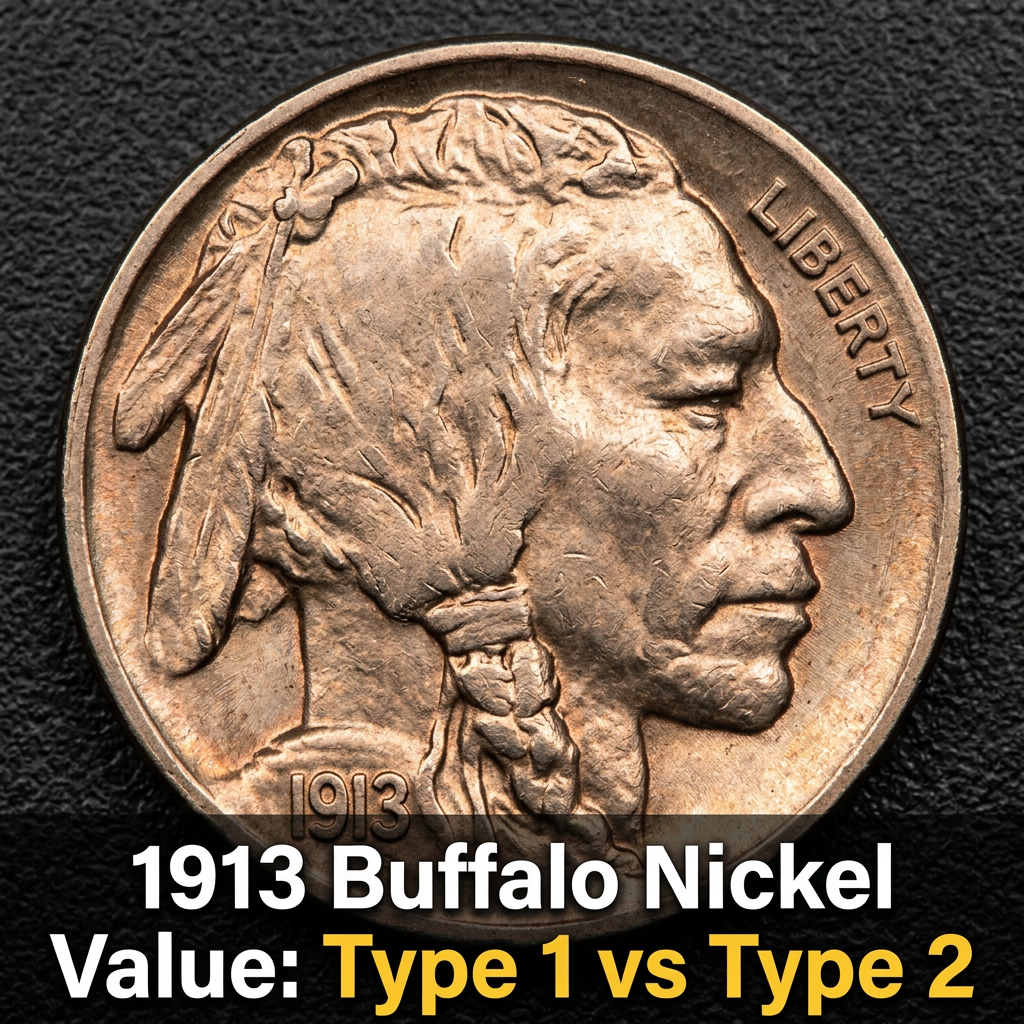
The 1913 Buffalo Nickel is worth anywhere from $10 in heavily circulated condition to over $10,000 for rare high-grade specimens. This introductory year for the iconic “Indian Head” design is famous among collectors because it features two distinct varieties that can significantly impact the amount of money in your pocket.
The First Year of the Buffalo Nickel and Its Unique History
In 1913, the United States Mint replaced the Liberty Head “V” Nickel with James Earle Fraser’s ruggedly beautiful Buffalo Nickel. It was a revolutionary design meant to capture the spirit of the American West. However, shortly after production began, officials noticed a problem. The original design featured the buffalo standing on a raised mound of dirt, which caused the “FIVE CENTS” inscription to wear away quickly in circulation.
To fix this, the Mint redesigned the reverse mid-year, flattening the ground into a straight line and placing the denomination in a recessed area. If you find one of these coins in an old jar, you first need to identify which version you have. While both are old, collectors often pay a premium for specific mint marks combined with these design changes. If you are unsure about what you have, using a top coin identifier app can help you distinguish the subtle differences in the mound design instantly.
For many everyday Americans, finding a 1913 nickel is like holding a piece of history. Because this was the transition year, millions were saved, but those in “Mint State” are where the real value lies. If your coin looks shiny and has no wear on the buffalo’s shoulder or the chieftain’s cheek, you might be looking at a significant payday. Using the CoinHix app can help you track these values as market prices fluctuate.
How to Tell the Difference Between Type 1 and Type 2
Identifying your coin is the first step to determining its worth. The “Type 1” 1913 Buffalo Nickel features a “Raised Mound.” Look at the bottom of the reverse side where the words “FIVE CENTS” are located. If the buffalo is standing on a rounded, bumpy hill, it is a Type 1. These were only minted for a few months before the design was altered.
The “Type 2” variety features a “Flat Ground” or a straight line beneath the buffalo’s hooves. The area where the denomination sits is framed by a thin straight line, protecting the text from friction. While Type 1 coins are more common in high grades because people saved them as novelties, the Type 2 coins—especially those minted in San Francisco—are often much harder to find in good condition.
The most accurate 1913 Type 1 Buffalo Nickel price data shows that even basic versions are highly liquid in the collector market. However, if yours has a small “S” or “D” under the words “FIVE CENTS,” the value jumps significantly. Collectors are always on the hunt for these mint-marked versions, making them the stars of any auction.
Valuation Table for 1913 Buffalo Nickels
Prices vary based on the mint mark (located on the reverse side) and the overall preservation of the coin. Use this table as a general guide for what your 1913 nickel might be worth today.
| Coin Variety & Mint Mark | Good (G-4) | Fine (F-12) | Uncirculated (MS-63) |
|---|---|---|---|
| 1913 Type 1 (Philadelphia) | $10 | $18 | $65 |
| 1913-D Type 1 (Denver) | $15 | $35 | $150 |
| 1913-S Type 1 (San Francisco) | $40 | $65 | $250 |
| 1913 Type 2 (Philadelphia) | $12 | $25 | $125 |
| 1913-D Type 2 (Denver) | $100 | $180 | $550 |
| 1913-S Type 2 (San Francisco) | $250 | $400 | $2,200+ |
What Makes the 1913-S Type 2 So Valuable?
If you look at the table above, you will notice the 1913-S Type 2 represents the “Holy Grail” for this specific year. While the Type 1 coins were minted in large quantities at all three mints, the Type 2 production at the San Francisco mint was much lower. Fewer than 1.3 million were produced, and since they were released later in the year, fewer people thought to save them as “first-year” keepsakes.
Finding one of these in a drawer can be a life-changing event for a casual hobbyist. Even in poor, worn-out condition, a 1913-S Type 2 can sell for several hundred dollars. If it is in pristine condition, it can easily fetch over $10,000 at a high-end auction. You should always check for the tiny “S” mint mark under the “FIVE CENTS” to see if you’ve hit the jackpot.
When you’re dealing with high-value items like these, it is critical to get a second opinion. Many hobbyists use CoinHix to cross-reference their finds with recent sales records. Understanding the current 1913 Buffalo Nickel value and rarity factors is essential before you attempt to sell your coin to a dealer or on an online marketplace.
Checking the Condition and Mint Marks
The value of your 1913 Buffalo Nickel is largely determined by its “grade.” Numismatists use a 70-point scale to grade coins. For a beginner, the most important thing to look for is “horn detail.” On the reverse side, if the buffalo’s horn is completely visible and sharp, your coin is likely in “Fine” condition or better. If the horn is missing, the coin is “Fair” or “Good.”
Mint marks are the other half of the equation. Coins with no mint mark were made in Philadelphia. A “D” indicates Denver, and an “S” indicates San Francisco. These letters are very small and often worn down. Using a magnifying glass or a high-quality camera with the CoinHix app can help you spot these marks clearly.
Cleaning your coins is a big no-no. Many people find an old 1913 nickel and want to scrub the dirt off to make it shine. However, collectors prefer “original skin” or natural patina. Scrubbing a coin creates microscopic scratches that can destroy up to 90% of its market value instantly. If you find a dirty coin, leave it exactly as it is.
Frequently Asked Questions
Q: Where is the mint mark on a 1913 Buffalo Nickel?
A: On both Type 1 and Type 2 versions, the mint mark is located on the reverse (tails) side. Specifically, it is located directly underneath the words “FIVE CENTS” at the very bottom of the coin. If there is no letter, it was minted in Philadelphia.
Q: Is a 1913 Buffalo Nickel without a date still worth money?
A: Buffalo Nickels are famous for having the date wear off because it was placed on a raised part of the design. A “dateless” 1913 nickel is generally only worth about 50 cents to a dollar as a curiosity, unless it is clearly a Type 2 variety, which might still hold a small premium.
Q: How can I tell if my 1913 nickel is a Type 1 or Type 2?
A: Look at the ground the buffalo is standing on. If the ground is a raised, rounded mound with the words “FIVE CENTS” on top of the mound, it is a Type 1. If the ground is a flat line with the words “FIVE CENTS” in a recessed space below it, it is a Type 2.
Q: Are all 1913 Nickels rare?
A: Not necessarily. Over 30 million Type 1 nickels were minted in Philadelphia alone, meaning they are quite common. However, any 1913 nickel in “Uncirculated” condition or any Type 2 coin from the Denver or San Francisco mints is considered rare and valuable.